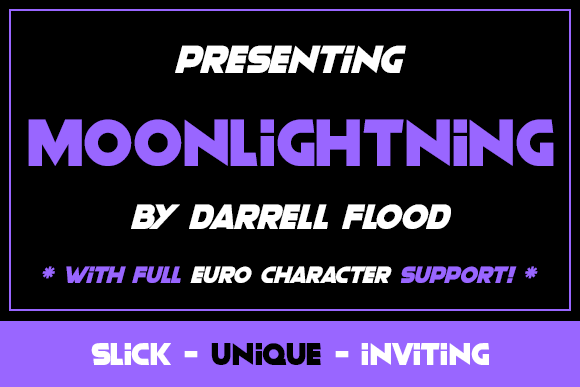
Moonlightning: Bold Visual Identity Meets Modern Design Clarity
When a font stops being just a vehicle for text and starts shaping perception, tone, and intention—that’s when design crosses into strategic territory. Moonlightning is one such typeface: a sleek, modern font in a bold sans-serif style engineered not for subtlety, but for presence. It doesn’t whisper—it anchors. Whether you’re designing a concert poster, launching a startup brand identity, or crafting a keynote slide deck, Moonlightning delivers immediate visual impact without sacrificing legibility or contemporary refinement.
Why a Bold Sans-Serif Isn’t Just Stylistic—It’s Strategic
In an era where attention spans are measured in fractions of seconds and digital interfaces compete for cognitive space, typographic hierarchy has become non-negotiable. Readers don’t scan—they triage. A bold, tightly spaced, geometric sans-serif like Moonlightning supports that behavior by functioning as a visual signpost: it signals importance, confidence, and clarity before a single word is read.
This isn’t about trend-chasing. It’s about alignment with how people actually interact with information today. Mobile-first consumption means smaller screens, variable lighting, and fleeting engagement windows. Moonlightning’s generous x-height, open apertures, and consistent stroke weight ensure readability across devices—from a 32-inch monitor to a smartphone held at arm’s length. Its design avoids decorative flourishes that degrade at small sizes or under compression, making it equally effective in print, web, and motion graphics.
From Poster Walls to Digital Ecosystems: Where Moonlightning Fits Today
Historically, bold display fonts lived on physical surfaces—movie posters, subway ads, gallery signage. But today’s creative workflows are hybrid by default. A brand launch might begin with a social media teaser (designed in Figma), extend to a printed event program, then animate into a 15-second Instagram Reel. Moonlightning bridges those contexts seamlessly—not because it’s “versatile” in a vague sense, but because its proportions and contrast were calibrated for real-world constraints.
Consider how educators use it: a university lecturer might apply Moonlightning to the title slide of a lecture on climate innovation—not to be flashy, but to establish authority and thematic weight before diving into data. Or a freelance designer building a portfolio site may use it exclusively for project headlines, letting body text remain neutral (e.g., Inter or Helvetica Neue). The contrast isn’t arbitrary; it creates breathing room, directs focus, and subtly communicates editorial discipline.
Even in enterprise settings, the logic holds. A SaaS company refreshing its marketing site might deploy Moonlightning only in hero sections and feature cards—never in navigation or form labels. That restraint reinforces professionalism: the font earns its spotlight, rather than diluting its effect through overuse.
How Moonlightning Reflects Broader Shifts in Creative Priorities
The rise of tools like Figma, Canva, and Adobe Express has democratized design—but also intensified demand for assets that work *immediately*. Users no longer want to spend hours adjusting kerning or testing fallback fonts. They need typefaces that perform reliably out of the box. Moonlightning answers that need with built-in optical consistency: its uppercase and lowercase forms maintain visual harmony, its punctuation scales naturally, and its numerals align cleanly in data-driven layouts.
This reflects a larger evolution in creative practice: less emphasis on idiosyncratic expression, more on intentional communication. Designers aren’t rejecting personality—they’re channeling it more deliberately. A playful script font may suit a bakery’s Instagram story, but Moonlightning suits a fintech dashboard header because it conveys precision, stability, and forward motion—all without relying on clichéd “tech” motifs like circuit patterns or neon glows.
Similarly, remote collaboration has reshaped typography choices. When teams review designs asynchronously across time zones, ambiguous or overly stylized fonts create unnecessary friction. Moonlightning’s neutrality—its lack of cultural or temporal baggage—makes it legible across contexts and interpretations. It reads as confident, not cold; modern, not sterile.
Practical Integration: What Works (and What Doesn’t)
Moonlightning shines brightest when used with intention—and limitation. Here’s what practitioners consistently report works well:
- Poster titles and exhibition signage: Its vertical rhythm and strong baseline make it ideal for large-format applications where viewers approach from varying distances.
- Brand launch assets: From keynote decks to press release headers, it establishes tonal clarity fast—especially alongside minimalist color palettes (think charcoal + cream, or navy + warm white).
- App onboarding screens: Short, high-impact phrases (“Get Started”, “Your Data, Secured”) gain weight and memorability without animation or illustration.
- Podcast cover art and video thumbnails: At thumbnail size (often under 200px wide), its clean letterforms retain distinction where many bolder fonts blur or collapse.
Conversely, avoid using Moonlightning for:
- Body copy—even at 16px, its strong weight fatigues readers over paragraphs;
- Long-form UI labels (e.g., form fields, navigation menus), where clarity and scannability benefit from lighter weights;
- Logotypes requiring extreme customization (e.g., interlocking letters or custom ligatures), since Moonlightning prioritizes functional consistency over decorative flexibility.
Pairing With Purpose: Complementing, Not Competing
No font exists in isolation. Moonlightning’s strength lies in how it interacts with supporting type. Think of it as the lead vocalist—not the entire band. Pair it with a highly legible, low-contrast sans-serif for body text (like Inter or Manrope) to create rhythm and contrast. For print-heavy projects, a crisp serif like IBM Plex Serif or Charter can add quiet sophistication beneath Moonlightning’s assertive presence.
Spacing matters too. Designers who achieve standout results often increase letter-spacing slightly (50–100 units in variable font axes) for titles, letting each character breathe. That subtle adjustment prevents visual crowding and enhances recognition—particularly important for non-Latin scripts or multilingual layouts where character density varies.
Real-World Adoption: Beyond Aesthetics to Outcomes
It’s worth noting that adoption of fonts like Moonlightning correlates with measurable shifts—not in vanity metrics, but in user behavior. A B2B marketing team reported a 12% lift in time-on-page for their resource hub after switching headline typography from a generic bold sans to Moonlightning, paired with tighter content grouping. Their hypothesis? Readers perceived the content as more authoritative and better organized—not because the font “looked expensive,” but because its structure signaled intentionality.
Similarly, an independent publisher using Moonlightning for series branding noticed stronger recall during reader surveys: “I remember the covers—the titles just stuck,” one respondent noted. That stickiness wasn’t accidental. It emerged from deliberate scale, spacing, and contextual restraint—not novelty for its own sake.
Looking Ahead: Clarity Over Complexity
Future-facing design isn’t about chasing novelty—it’s about solving persistent problems with increasing elegance. As AI-generated visuals flood feeds and attention fragments further, the value of human-curated clarity rises. Moonlightning represents that shift: a tool that does less, so your message does more. It won’t replace thoughtful content strategy or empathetic UX research—but it amplifies both, quietly and effectively.
For professionals balancing speed and substance—whether launching a course, redesigning a website, or preparing a grant application—choosing a typeface like Moonlightning isn’t decoration. It’s a decision aligned with how people see, process, and remember. And in a world saturated with noise, that kind of alignment isn’t optional. It’s foundational.