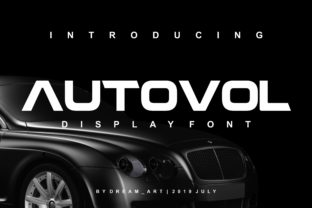
Autovol: A Futuristic Sans Serif with Purpose and Personality
Autovol stands out not because it shouts, but because it commands attention with quiet confidence. It’s a sans serif typeface built for clarity and forward motion—designed with geometric precision yet animated by subtle idiosyncrasies that give it character without compromising legibility. Unlike many “futuristic” fonts that lean heavily into sharp angles or exaggerated distortion, Autovol balances innovation with restraint. Its letterforms are clean and confident, with open apertures, consistent stroke contrast, and carefully tuned proportions that support both screen and print use.
What Makes Autovol Distinctive—Beyond the Buzzwords
At first glance, Autovol reads as modern—but closer inspection reveals thoughtful deviations from standard neo-grotesque conventions. The uppercase A features a gently tapered crossbar; the lowercase g uses a single-story form with a fluid, almost calligraphic exit stroke; and the numerals include true italics with slight forward tilt—not just slanted roman glyphs. These aren’t gimmicks. They’re functional refinements that improve rhythm in body text and add visual interest in headlines.
The font family includes six weights (Thin through Black), each with matching italics, plus corresponding variable font axes for weight and width. This level of typographic infrastructure matters: it means Autovol can scale from a delicate caption in a design system’s lightest weight to a commanding hero headline in Black—without switching families or sacrificing harmony. The variable axis also allows fine-tuned optical adjustments for responsive layouts, such as tightening width on narrow mobile viewports while maintaining readability.
Where Autovol Excels in Real-World Use
Autovol performs especially well in contexts where tone and technical clarity intersect. Think tech startups launching a new SaaS platform, independent publishers crafting editorial identities, or educators building branded course materials that need to feel current without seeming ephemeral. Its neutrality is intentional—it doesn’t impose personality so much as amplify the message behind it.
In UI work, Autovol’s generous x-height and clear letter differentiation (especially between I, l, and 1) reduce cognitive load. We’ve seen it used effectively in dashboard interfaces where data density is high, and users scan quickly. In branding, it holds up across applications: crisp on a business card, balanced on a podcast cover, and legible at small sizes in app notifications.
One practical observation: Autovol’s medium weight strikes an optimal balance for most digital body copy—neither too thin to lose impact nor too heavy to fatigue readers over longer passages. Its italic variants maintain structural integrity rather than collapsing into decorative flourishes, making them viable for emphasis, citations, or foreign terms without disrupting flow.
Who Benefits Most—and When It Might Not Fit
Freelancers and small studios often choose Autovol when they need a versatile, ownable typeface that communicates competence and forward-thinking sensibility—without requiring custom lettering or extensive licensing negotiations. It’s particularly useful for projects with tight timelines: its consistency across weights and formats reduces decision fatigue during layout refinement.
Marketers building campaign assets appreciate how Autovol supports hierarchy without relying on multiple type families. A single weight can serve as a subheading, while Black anchors a CTA button—and the same font appears seamlessly in email headers, social banners, and landing page copy. That cohesion saves time and strengthens brand recognition.
That said, Autovol isn’t ideal for every scenario. Its character emerges most clearly at larger sizes; in very small print (under 10pt), some of its subtler details—like the tapered terminals on c or e—may soften. For long-form book typography intended for extended reading, a more traditional humanist sans (like Inter or Source Sans Pro) may offer slightly better paragraph-level comfort due to increased letter spacing flexibility and lower contrast.
Also worth noting: while Autovol supports Latin, Greek, and Cyrillic scripts, its extended language coverage is limited compared to super-families like IBM Plex Sans. Projects targeting multilingual audiences beyond Western Europe should verify glyph completeness before committing to full implementation.
Practical Integration Tips
If you’re evaluating Autovol for a live project, start with these low-risk, high-signal tests:
- Test hierarchy in context: Set your primary headline, subhead, and body text using only Autovol weights—no other fonts. Does the visual relationship feel intentional and scalable?
- Check contrast in real environments: View samples on actual devices—not just design tools. Does the Thin weight remain legible in low-light mode? Does Black hold up against busy background imagery?
- Validate accessibility: Run a quick contrast check (e.g., WebAIM Contrast Checker) using your intended color pairings. Autovol’s open forms help, but contrast remains the designer’s responsibility.
- Assess file impact: If loading performance matters (e.g., for high-traffic websites), compare Autovol’s WOFF2 size against alternatives. Its efficient hinting and streamlined glyph set typically result in smaller payloads than similarly featured families.
Long-Term Value and Design Longevity
Typography choices often outlive their initial context. Autovol avoids trend-driven extremes—no excessive condensation, no artificial distressing, no forced asymmetry. That gives it staying power. We’ve seen brands adopt Autovol for rebrands in 2021 and still use it confidently in 2024 refreshes, simply adjusting weight or tracking rather than overhauling their entire typographic system.
Its licensing model is straightforward: one-time purchase for desktop, web, and app use—with no per-page or per-user fees. That predictability helps creators budget realistically, especially when scaling across multiple platforms or client projects. There’s no subscription layer to manage, no usage caps to monitor mid-campaign, and no risk of sudden license changes.
Ultimately, Autovol earns its place not by being flashy, but by being dependable—capable of supporting serious ideas with appropriate gravity, while leaving room for voice and variation. It doesn’t solve every typographic challenge, but for professionals who value intentionality, flexibility, and quiet distinction, Autovol delivers measurable utility. Whether you’re refining a microsite’s interface, developing a pitch deck for investors, or designing packaging for a hardware startup, it offers a grounded yet distinctive foundation—one that feels both contemporary and capable of evolving alongside your work.