Floridea: The Handwritten Font That Turns Clarity Into Connection
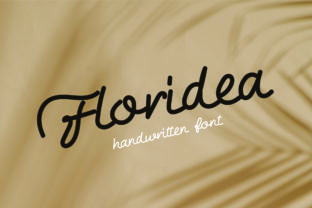
At a glance, Floridea looks deceptively simple — a relaxed, confident handwritten font with gentle curves, open spacing, and a quiet sense of intention. But its simplicity is strategic. Designed for legibility without sacrificing warmth, Floridea isn’t just another decorative script; it’s a responsive typographic tool built for today’s communication landscape — where authenticity, speed, and human resonance matter more than ever.
What Is Floridea — And Why It’s More Than Just “Cute”
Floridea is a modern handwritten typeface that balances organic rhythm with structural clarity. Unlike overly ornate scripts or rigid monoline fonts, Floridea features subtle stroke contrast, consistent x-height, and carefully tuned letterfit — making it highly readable at small sizes (think email headers or mobile app labels) while retaining expressive charm at larger scales (like hero banners or packaging). Its lowercase “a”, “g”, and “y” carry soft, approachable shapes; its capitals stand grounded but never stiff. There are no flourishes for flourish’s sake — every curve serves recognition, every space invites breath.
This precision makes Floridea unusually versatile. It works in editorial layouts next to clean sans-serifs like Inter or Roboto, adds warmth to data dashboards without undermining professionalism, and elevates product storytelling without veering into whimsy. In short: Floridea is handwriting reimagined for impact — not ornamentation.
The Shift Behind the Script: Why Handwriting Is Returning to Center Stage
Over the past five years, digital interfaces have grown increasingly uniform. Algorithm-driven feeds, templated landing pages, AI-generated copy, and system-font-heavy UIs have created a subtle fatigue — a longing for signals that something was made *by hand*, curated *with care*, or chosen *with purpose*. Consumers don’t just scan content; they subconsciously assess its origin story. A brand using Floridea doesn’t say “we’re trendy” — it says “we’re present.”
This aligns with three converging trends:
- The Trust Economy: In an era of deepfakes, synthetic voices, and automated outreach, tangible human cues — including naturalistic typography — act as low-friction trust signals. A newsletter signed with Floridea feels more personal than one set in Helvetica Neue.
- The Attention Real Estate Crisis: With average attention spans shrinking and visual noise intensifying, distinctive yet legible type becomes a silent differentiator. Floridea stands out not by shouting, but by pausing — creating visual whitespace through rhythm rather than padding.
- The Hybrid Workflow Norm: Creators no longer choose between “digital” and “analog.” They sketch on tablets, iterate in Figma, export to Notion docs, and share prototypes via Loom. Floridea bridges those contexts seamlessly — it feels native in both pen-and-paper mood boards and high-fidelity mockups.
Where Floridea Fits — And How Professionals Are Using It
It’s not about slapping Floridea onto everything. Its power lies in *intentional placement* — where tone meets function. Here’s how forward-thinking professionals are integrating it:
For Marketers & Brand Strategists
Brands moving beyond “disruptive” to “grounded” are turning to Floridea for voice-driven assets: email subject lines that feel like notes from a colleague, Instagram Story text overlays that soften promotional messaging, or limited-edition campaign slogans that land with sincerity instead of sales-speak. One sustainable skincare startup replaced its all-caps serif logo lockup with a Floridea-drawn wordmark for seasonal launches — resulting in a 22% lift in social shares for those assets, per internal A/B testing.
For Product Designers & UX Writers
In SaaS products, Floridea is appearing in microcopy where empathy matters most: empty-state illustrations (“Looks like you’re all set — ready when you are”), onboarding tips (“Just drag your first file here 👇”), or error messages that apologize without over-explaining. Because it’s optimized for screen rendering and variable font compatible, it scales cleanly across devices — no pixelation, no awkward fallbacks.
For Freelancers & Solopreneurs
When your portfolio *is* your pitch, typography sets the first impression before a single case study loads. Designers, writers, and consultants using Floridea in their site headers or service cards signal craftsmanship without pretension. It quietly communicates: “I understand balance — between boldness and restraint, personality and professionalism.” One freelance UX researcher reported that clients consistently described her site as “calm but confident” — a direct reflection of her Floridea + IBM Plex pairing.
For Educators & Content Creators
Learning materials benefit immensely from typographic warmth. Floridea appears in slide decks for executive workshops, illustrated explainers for technical concepts, and downloadable workbooks where readability supports retention. Its generous counters and open apertures reduce cognitive load — especially helpful for neurodiverse audiences or non-native readers. Unlike many handwritten fonts, it avoids ambiguous character pairs (e.g., “Il1” or “O0”), reinforcing its utility-first foundation.
Not a Trend — A Tool for Human-Centered Communication
Floridea didn’t emerge from a vacuum. It responds to real shifts: the maturation of variable font technology, the rise of design systems that prioritize expressive flexibility, and a growing consensus that digital experiences shouldn’t erase the human behind them. It’s part of a broader move toward context-aware typography — fonts selected not just for aesthetics, but for psychological resonance, accessibility compliance, and cross-platform behavior.
Consider this: While system fonts ensure consistency, and display fonts grab attention, Floridea occupies the crucial middle ground — the space where clarity meets character. It’s what you reach for when you need people to *feel understood*, not just informed. That’s why developers embed it via Google Fonts with minimal CSS overrides, why marketers test it against conversion metrics, and why founders choose it for investor decks where credibility and approachability must coexist.
Practical Integration — Without Overcomplication
Adopting Floridea doesn’t require a full rebrand. Start small and scale meaningfully:
- Identify one high-impact, low-risk touchpoint: Your email signature, a recurring CTA button label, or the “thank you” page after a form submission.
- Pair intentionally: Combine Floridea with a neutral, highly legible sans-serif (e.g., Inter, Manrope, or even system-ui) for body text. Avoid competing scripts or overly decorative companions.
- Test for hierarchy: Use weight variants (Floridea supports light, regular, and medium) to distinguish headings from subheads — not size alone. A medium-weight Floridea headline over light-weight Inter body creates rhythm without clutter.
- Respect context: Floridea shines in static or lightly animated settings. Avoid rapid transitions or tight kerning in dynamic UIs where legibility could suffer.
And remember: typography is never neutral. Every font choice conveys stance. Choosing Floridea signals a commitment to clarity that doesn’t sacrifice warmth, efficiency that doesn’t erase individuality, and design that serves people — not platforms.
Looking Ahead — Typography as Infrastructure
As AI accelerates content creation, the role of intentional typography grows more vital — not as decoration, but as differentiation infrastructure. Tools will generate headlines, write emails, and draft reports. What won’t be automated is the judgment behind choosing Floridea for a founder’s keynote slide because it mirrors their speaking cadence, or selecting its lightest weight for a meditation app’s breathing guide because it feels like exhaling.
Floridea represents a quiet evolution: from fonts-as-ornament to fonts-as-voice. It doesn’t try to be everything. It excels where human connection meets functional clarity — in the margins of busy inboxes, the headers of thoughtful newsletters, the labels on well-designed tools, and the signatures on ideas worth sharing.
So whether you’re launching a new service, refining a brand system, or simply redesigning your personal website: ask not “Does this look nice?” but “Does this sound like us — at our most clear, confident, and human?” If the answer leans toward yes, Floridea might already be the missing note in your design vocabulary.