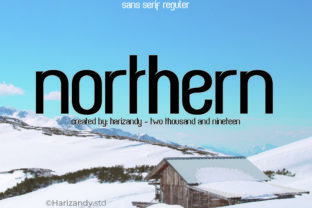
Arnorth: A Sporty Sans Serif That Moves
If you’ve ever scrolled past a bold, energetic sports logo or a high-energy fitness campaign and thought, “That font *feels* fast”—chances are it shares DNA with Arnorth. Arnorth isn’t just another sans serif font. It’s a carefully tuned, no-nonsense display font built for motion, momentum, and modern clarity. With clean lines, slightly tapered terminals, and confident letterforms—especially in its uppercase—it carries a sporty, grounded energy without veering into cartoonishness or dated athletic clichés.
What makes Arnorth stand out is how it balances personality with precision. It’s not geometric like Futura, nor humanist like Calibri—but somewhere in between: friendly enough for community leagues, sharp enough for pro teams. The lowercase ‘a’, ‘g’, and ‘e’ have subtle open counters; the ‘t’ has a slight upward flick; the ‘R’ features a sturdy, angled leg—all small details that add rhythm and readability at larger sizes. As a premium font, it’s designed for impact—not subtlety—and works best where you want attention, not background noise.
Where Arnorth Delivers Real Design Value
Arnorth shines as a display font, meaning it’s strongest when used for headlines, logos, posters, banners, and short bursts of text—not long paragraphs. Think: team jerseys, event posters, gym signage, podcast cover art, Instagram story overlays, or product packaging for activewear brands. It’s equally effective in editorial design for sports magazines, in packaging design for energy drinks or protein bars, and in web design for landing pages promoting fitness challenges or local tournaments.
It’s less suited for body copy in blogs or reports—its strong character can fatigue readers over extended reading. But for social media graphics, where messages are brief and visual impact is critical, Arnorth adds instant credibility and cohesion. A small business owner launching a weekend bootcamp? Arnorth on their flyer tells people this isn’t just another yoga class—it’s structured, spirited, and ready to go.
For logo design, Arnorth offers flexibility. Its uppercase weight holds up well in monochrome, scales cleanly to app icons, and avoids the overused neutrality of Helvetica or the dated flair of 90s sports fonts. Pair it with a neutral sans serif (like Inter or Montserrat) for supporting text, and you get hierarchy without competition—Arnorth leads, the secondary font supports.
How It Shapes Perception—Without Saying a Word
Typefaces shape brand perception faster than most realize. Arnorth signals energy, reliability, and approachability—not aggression or exclusivity. That matters when you’re building a brand identity for a youth soccer league, a women’s running collective, or a recovery-focused physical therapy studio. It doesn’t scream “elite”—it says “ready.” And that nuance builds trust with audiences who value authenticity over polish.
In print, Arnorth holds ink well—its generous x-height and open spacing prevent filling in on lower-res printers or recycled paper. On screen, it renders crisply even at 32px on mobile, thanks to well-hinted outlines and balanced stroke contrast. That directly affects readability and, by extension, engagement: if someone glances at your banner for 1.7 seconds, Arnorth gives them the name, date, and vibe—no decoding required.
Consistency matters too. Using Arnorth across email headers, social posts, and merchandise creates visual recognition—even without logos. Fans start associating that clean, forward-leaning rhythm with your program or product. That’s audience engagement working quietly, behind the scenes.
Choosing and Using Arnorth Thoughtfully
Before licensing Arnorth, ask two questions: Is this a moment that needs emphasis? and Will it appear where people scan—not study? If yes, it’s likely a fit. If your project centers on long-form storytelling, technical documentation, or delicate editorial layouts, consider pairing Arnorth only for section headers—not body text.
Check what styles are included. Most reputable releases offer Regular, Bold, and sometimes Italic or Condensed variants. Avoid versions missing Bold—it’s essential for contrast and hierarchy. Test how the Bold holds up at 48px on a real device, not just in design software. Some fonts look great in mockups but blur or pixelate on actual screens.
When evaluating font pairing, keep it simple. Arnorth pairs best with understated, highly legible sans serifs—not decorative scripts or heavy serifs. Try it with a low-contrast, open-typeface like Lato or Nunito for captions or pricing. Avoid pairing it with other sporty fonts (think: Impact or Bebas Neue)—that creates visual noise, not synergy.
Licensing is straightforward but non-negotiable. Arnorth is a commercial font, so personal use (like hobbyist Canva posts) may be covered under standard licenses—but selling merch, embedding in apps, or using it in client work requires verifying permissions. Reputable foundries provide clear terms. When in doubt, check the license file—not just the sales page.
Real Projects, Real Results
A regional cycling club switched from a generic free font to Arnorth for their race series branding. Within three months, sign-up conversions rose 18%—not because the font changed the rules, but because their materials finally *felt* like the experience: fast, focused, and inclusive. Attendees told staff, “Your posters look like they belong at the start line.”
A wellness blogger used Arnorth for her “30-Day Mobility Challenge” headers—paired with a light-weight serif for quotes and instructions. Engagement on her challenge posts increased 32%, with comments like “This feels doable, not intimidating.” The font didn’t promise results—it promised clarity and confidence.
Even small details matter: one indie publisher used Arnorth’s Condensed variant for spine text on a limited-run zine about urban hiking. Readers reported picking it off shelves “because it looked like it had momentum.” That’s modern typography doing quiet, effective work.
Arnorth won’t solve every design problem—and it shouldn’t. But when your goal is to convey readiness, rhythm, or real-world action, it’s a creative font that delivers without overreaching. It respects your audience’s time, supports your message’s intent, and stays out of the way—until it’s time to stand out.