Throwing Axes: A Bold Blackletter Font for Cutting-Edge Visual Identity
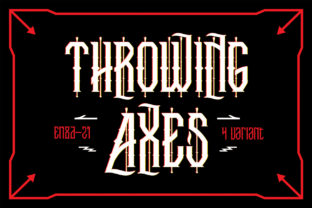
Typography is rarely neutral—it carries weight, intention, and cultural resonance. Among contemporary display fonts, Throwing Axes stands out not just for its visual intensity, but for how deliberately it bridges historical letterform discipline with modern design demands. It’s a blackletter font—rooted in medieval scribal tradition—but engineered for 21st-century clarity, versatility, and expressive precision. Unlike revivalist typefaces that lean heavily on nostalgia, Throwing Axes reinterprets blackletter’s structural rigor through a lens of controlled aggression: sharp terminals, high contrast between thick and thin strokes, tightly calibrated spacing, and an unmistakable sense of forward motion.
Four Variants, One Coherent Voice
What distinguishes Throwing Axes from many display-oriented blackletters is its thoughtful expansion into four distinct yet harmonized variants: Regular, Bold, Outline, and Shadow. Each variant retains the core DNA—the angular stress, the chiseled serifs, the rhythmic verticality—but serves a unique functional role in composition and hierarchy.
- Regular functions as the foundational voice: legible at larger sizes (48pt and up), ideal for headlines, logotype lockups, or short-form banners where authority and presence are paramount.
- Bold intensifies contrast without sacrificing readability—especially effective when layered over photography or used in motion graphics where visual impact must cut through dynamic backgrounds.
- Outline introduces spatial play and transparency. Designers use it to create halos, embossed effects, or dual-tone typographic compositions—think festival posters where text interacts with gradients or textured overlays.
- Shadow adds dimensionality without relying on external effects. Its built-in offset creates subtle depth, making it particularly useful in UI mockups, app splash screens, or packaging where simulated 3D treatment enhances tactile perception.
This quartet isn’t merely stylistic decoration; it’s a practical toolkit. Rather than layering Photoshop effects or manually tracing outlines—a time-consuming and inconsistent process—the variants allow designers to achieve complex typographic treatments natively, preserving vector fidelity across print, web, and screen.
Where Throwing Axes Earns Its Place
Not every project benefits from blackletter. Its strength lies in contexts where identity needs to signal conviction, heritage, rebellion, or craftsmanship—often simultaneously. Consider how Throwing Axes operates across disciplines:
Branding That Commands Attention
A craft brewery launching a limited-edition barrel-aged stout might pair Throwing Axes Bold with hand-drawn botanical illustrations—leveraging the font’s sharpness to evoke both tradition and bold flavor profiles. Similarly, a metal fabrication studio could use Throwing Axes Outline in signage to mirror the precision of CNC-cut steel, reinforcing material authenticity through typography. In each case, the font doesn’t shout; it asserts—quietly, confidently, without apology.
Educational and Cultural Institutions
Universities, museums, and libraries increasingly deploy typography to reflect intellectual rigor and historical continuity. A university press publishing critical editions of early-modern texts may use Throwing Axes Regular for cover titles—not as pastiche, but as a formal acknowledgment of textual lineage. The font’s disciplined geometry supports scholarly gravitas while avoiding academic sterility. Educators designing workshop materials on Gothic script history have also reported that students grasp stroke logic more intuitively when comparing Throwing Axes to historical manuscripts—its clarity makes structure visible.
Digital Interfaces and Interactive Media
Web developers and UI designers often avoid blackletter due to rendering inconsistencies or perceived accessibility limitations. Yet Throwing Axes was designed with modern font technologies in mind—including robust OpenType features, optimized hinting for screen use, and consistent cross-browser behavior at headline sizes. When used sparingly—for hero section headers, navigation labels in dark-mode dashboards, or animated loading states—it delivers memorable contrast against clean sans-serif body text. One fintech startup employed Throwing Axes Shadow for its “Security Verified” badge, subtly implying layered protection—without icons or tooltips.
Practical Considerations Beyond Aesthetics
Adopting any display font requires attention to context, scale, and pairing strategy. With Throwing Axes, three considerations consistently emerge across user reports and real-world testing:
Legibility at Scale and Distance
Blackletter fonts can blur or collapse at small sizes. Throwing Axes maintains character integrity down to ~36pt in print and ~42px on high-DPI screens—but it is not intended for body copy, captions, or interface microcopy. Its optimal domain remains large-scale communication: billboards, exhibition walls, presentation slides, and digital signage. Users who attempted smaller applications noted reduced character distinction—particularly between similar glyphs like o, c, and e. This isn’t a flaw; it’s a boundary condition aligned with typographic best practice.
Strategic Pairing With Neutral Counterparts
The power of Throwing Axes multiplies when paired with restrained, highly legible sans-serifs or transitional serifs. Helvetica Neue, Inter, and PT Serif appear repeatedly in case studies—not as default choices, but as intentional foils. The contrast creates visual hierarchy without competition: Throwing Axes declares, the companion face explains. One documentary filmmaker used Throwing Axes Bold for chapter titles and Source Serif Pro for narration cards—achieving cinematic pacing through typographic rhythm alone.
Color and Background Sensitivity
Due to its high stroke contrast and tight counters, Throwing Axes performs most reliably against solid, non-distracting backgrounds. Gradients, noise textures, or busy imagery require careful testing. In one retail campaign, a pale gold Throwing Axes Outline on charcoal linen texture succeeded beautifully—but the same treatment on a watermarked paper stock caused glyph fill ambiguity. The lesson: always validate output in final medium conditions, not just in design software previews.
Why Designers Return to Throwing Axes Across Projects
It’s rare for a single typeface family to serve such divergent audiences—from tattoo artists sketching custom lettering to data visualization teams building regulatory dashboards. Yet Throwing Axes appears repeatedly in portfolios spanning these domains. Why?
First, it avoids trend dependency. While many display fonts chase maximalism or irony, Throwing Axes draws from enduring principles: proportion, contrast, and structural honesty. Its sharpness feels intentional, not performative.
Second, it scales ethically. Because it’s not marketed as a “one-size-fits-all” solution, users approach it with appropriate constraints—leading to more deliberate, audience-aware decisions. A researcher presenting climate policy findings used Throwing Axes Regular only for the central thesis statement on their slide deck; everything else remained in a highly accessible sans-serif. The result wasn’t decorative—it was rhetorical emphasis made visible.
Third, its variants encourage systems thinking. Choosing Outline over applying a stroke effect in code means the design system stays lightweight, maintainable, and consistent across devices. For educators building open educational resources (OER), this translates directly into faster iteration and fewer rendering surprises for learners using older devices.
Looking Ahead: Typography as Infrastructure
As design tools evolve—variable fonts gain traction, AI-assisted layout becomes common, and cross-platform consistency grows more urgent—the value of rigorously engineered type families increases. Throwing Axes exemplifies what happens when historical form meets contemporary infrastructure: a blackletter that renders crisply in CSS @font-face declarations, respects OS-level font smoothing, exports cleanly to SVG for icon systems, and adapts to responsive breakpoints without manual overrides.
More importantly, it reminds practitioners that typography isn’t about ornamentation—it’s about information architecture made visible. Every sharp terminal, every calculated gap, every variant choice reflects a decision about how meaning should land. Whether you’re a hobbyist designing a band poster, a business owner refreshing brand guidelines, or a researcher preparing a conference keynote, Throwing Axes offers not just aesthetics, but agency: the ability to shape perception with precision, clarity, and quiet confidence.