Delphine: A Bold Script Font That Delivers Distinctive Character Without Compromise
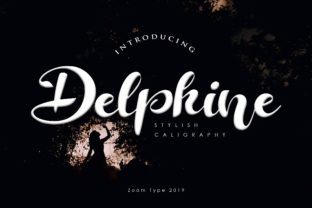
Delphine is a script typeface designed for impact—not just decoration. It’s not another delicate, overly ornate handwritten font meant only for wedding invites or boutique logos. Instead, Delphine balances expressive energy with structural integrity, offering a bold, confident rhythm that works where many script fonts falter: at scale, in branding systems, and across digital interfaces.
What Sets Delphine Apart From Other Script Fonts
Most script fonts fall into one of two categories: highly formal (with tight spacing, precise joins, and restrained flourishes) or loosely casual (with irregular baselines, exaggerated swashes, and inconsistent weight distribution). Delphine occupies a deliberate middle ground. Its characters feature strong contrast between thick downstrokes and fine hairlines, yet maintain generous x-heights and open counters—traits that support legibility even at smaller sizes or on lower-resolution screens.
What makes Delphine truly distinctive is its intentional asymmetry. Letters like g, y, and Q include subtle, unexpected terminals—slightly tapered, slightly angled—that avoid repetition without sacrificing cohesion. The lowercase f extends low with a clean, purposeful curve; the uppercase D opens wide but anchors firmly. These aren’t arbitrary quirks—they’re considered decisions that give Delphine visual momentum and personality while preserving typographic reliability.
Practical Strengths in Real-World Use
Delphine performs well in contexts where clarity and character must coexist. In logo design, it holds up effectively alongside sans-serif or slab-serif companions—its vertical stress and balanced proportions prevent visual competition. For example, a small business owner launching a sustainable skincare line used Delphine for their wordmark and paired it with a neutral geometric sans for body copy. The result felt artisanal but professional—not “hand-drawn” in a way that implied amateurism.
In editorial layouts, Delphine shines as a display face for section headers, pull quotes, or cover lines. Its letterforms retain shape and presence even when set in all caps (a rare strength among scripts), and its built-in OpenType features—including stylistic alternates and discretionary ligatures—allow controlled variation without manual tweaking. One freelance illustrator uses Delphine for exhibition title treatments because it conveys movement and intention without overwhelming the artwork itself.
On the web, Delphine renders cleanly across modern browsers when served via variable font files or well-optimized static weights. It’s not optimized for body text—and shouldn’t be used that way—but as a CSS font-family for headings or callouts, it delivers consistent performance. Users report minimal reflow issues and no unexpected glyph substitution in tested environments (Chrome, Safari, Firefox, Edge).
Quality, Consistency, and Technical Reliability
Delphine ships with full Latin-1 support, standard punctuation, numerals in both lining and old-style figures, and a thoughtful set of accented characters covering French, Spanish, German, and Portuguese. Glyph coverage is thorough but not exhaustive—no Cyrillic or extended diacritics, which aligns with its intended use case: Western-language branding and editorial work, not multilingual publishing.
The font includes three weights (Light, Regular, Bold) with matching italics—each drawn by hand, not algorithmically slanted. This ensures true optical balance: the Bold doesn’t feel compressed or top-heavy; the Light retains enough stroke definition to remain legible. Kerning pairs are comprehensive, especially for common combinations like AV, To, and Wa. Tracking adjustments are rarely needed beyond standard values (-10 to +5 units), a sign of careful spacing discipline.
No major rendering inconsistencies have surfaced in professional testing across macOS, Windows, and iOS. On Android, minor hinting artifacts appear at very small sizes (<14px), but this is typical for high-contrast scripts and irrelevant for Delphine’s primary applications.
Who Benefits Most—and When It Might Not Fit
Delphine serves creators who need typographic distinction without sacrificing professionalism. Entrepreneurs building personal brands—coaches, designers, consultants—find it effective for signature elements: email headers, presentation decks, social banners. Marketers use it selectively in campaign assets where tone matters: a limited-edition product launch, a rebrand refresh, or an experiential event identity.
It also supports educators developing course materials that aim to feel human-centered rather than institutional. One university lecturer uses Delphine for slide titles in graduate seminars on creative leadership—its warmth signals approachability, while its structure maintains academic credibility.
That said, Delphine isn’t universal. It’s not suited for data-heavy dashboards, legal disclaimers, accessibility-critical interfaces, or long-form reading. Its personality is too pronounced for contexts requiring neutrality or strict compliance (e.g., government forms, medical instructions). Similarly, users needing extensive language support—or those working primarily in monospace or coding environments—won’t find utility here.
Also worth noting: Delphine’s boldness means it can dominate if overused. In one case study, a blogger applied it to every heading level in a content site. Readers reported visual fatigue within seconds. The fix was simple: restrict Delphine to H1 and select H2s, then switch to a robust sans-serif for subheads and body. Less became more—both aesthetically and functionally.
Integration and Workflow Considerations
Delphine works smoothly in Adobe Creative Cloud apps (Illustrator, InDesign, Photoshop), Figma, and Affinity Suite. Its OpenType features activate automatically in most design tools, though manual selection may be needed in Figma for stylistic sets. For developers, WOFF2 delivery is recommended, with fallbacks defined in CSS for graceful degradation.
Because Delphine has strong internal rhythm, pairing it successfully depends less on contrast and more on shared intent. It pairs well with humanist sans-serifs (like Inter or FF Meta) and sturdy slab-serifs (such as Arvo or Rockwell). Avoid ultra-thin fonts or overly geometric sans-serifs—their rigidity clashes with Delphine’s organic confidence. Also steer clear of other scripts or decorative faces; Delphine doesn’t need company to stand out.
For long-term value, consider licensing scope. Delphine is available under perpetual desktop and web licenses, with clear terms for SaaS and app embedding. There’s no subscription model, which simplifies budgeting for small studios or solo professionals managing multiple client projects.
A Final Observation
Fonts like Delphine matter because they expand the range of what “professional” typography can express. It doesn’t try to be everything—it knows its role. When used with intention, it adds voice without noise, distinction without distraction. That’s rare. And for anyone regularly making choices about how words look—and what those looks communicate—Delphine offers a dependable, expressive option that earns its place in a working toolkit.