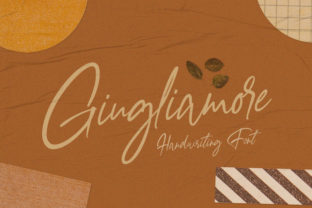
Giugliamore: A Hand-Written Signature Font Built for Clarity and Character
Giugliamore stands out not because it shouts, but because it speaks with quiet confidence. It’s a modern hand-written signature font—designed to feel personal and intentional without sacrificing legibility or typographic integrity. Unlike many script fonts that lean heavily into flourishes or exaggerated slant, Giugliamore balances organic flow with restrained structure. That balance makes it unusually versatile: it works where other handwritten fonts falter—in branding systems, digital displays, editorial headers, and even responsive interfaces.
What Makes Giugliamore Distinctive
At its core, Giugliamore is built on human rhythm—not algorithmic mimicry. The letterforms reflect consistent pressure variation, subtle entry and exit strokes, and natural spacing between characters. But what sets it apart is how evenly those qualities are applied across the full character set, including punctuation, numerals, and multilingual glyphs (Latin-based languages with diacritics). There’s no “fallback” feeling when you type an accented é or a fraction like ¾—the design language holds.
The weight is medium—not too light to vanish at small sizes, not so bold that it overwhelms supporting text. Its x-height is generous, improving readability in both print and screen contexts. And unlike some script fonts that collapse into illegibility below 24px, Giugliamore remains decipherable down to 16px in high-resolution environments—especially useful for mobile navigation labels or compact UI elements where personality matters but clarity is non-negotiable.
Practical Strengths in Real Projects
Giugliamore excels where authenticity and professionalism intersect. Consider a boutique consultancy launching a new website: using Giugliamore for the logo and section headers—paired with a clean sans-serif like Inter or Lato for body copy—creates immediate visual distinction. It signals craftsmanship without seeming contrived. Similarly, educators designing course landing pages or workshop materials find Giugliamore effective for headlines and callout boxes—it adds warmth without undermining authority.
For freelancers and small business owners, Giugliamore functions well across touchpoints. A photographer might use it for watermark signatures overlaid on portfolio images; its slight irregularity helps avoid the “stamped” look of rigid monoline scripts. A podcast host could apply it to episode title cards—its rhythmic consistency supports brand recognition over time, especially when animated subtly in intro sequences.
It also performs reliably in variable environments. Tested across browsers (Chrome, Safari, Firefox) and platforms (macOS, Windows, iOS), Giugliamore renders consistently with OpenType features enabled—including contextual alternates and ligatures. These aren’t decorative extras; they prevent awkward collisions (like “f” + “l” or “t” + “h”) and maintain natural word shapes. That reliability reduces the need for manual kerning adjustments—a real time-saver during rapid iteration.
Where Giugliamore Fits—and Where It Doesn’t
Giugliamore isn’t intended for dense body text, long-form articles, or accessibility-critical interfaces like medical forms or legal disclosures. Its connected script nature limits scannability in paragraph format, and screen readers interpret it as decorative rather than semantic—so it should never replace heading hierarchy or serve as primary interface text.
It also assumes a certain level of typographic awareness from the user. Pairing Giugliamore effectively requires attention to contrast: it needs breathing room, generous line height, and complementary typefaces with clear contrast in stroke modulation and proportion. Throwing it next to another high-contrast script—or stacking it with overly geometric sans-serifs—can create visual tension instead of harmony.
That said, its licensing model (standard desktop + web license, with optional extended options for app or broadcast use) aligns with how most professionals actually work. You’re not paying for unused permissions—you get what you need for common deployment scenarios without complexity.
Who Benefits Most—and How to Use It Well
Entrepreneurs building early-stage brands often gravitate toward Giugliamore because it delivers distinctiveness without requiring custom illustration or extensive design resources. A coffee roaster, ceramicist, or independent therapist can use it across business cards, Instagram highlights, and email newsletter banners—creating cohesion without repetition.
Marketers evaluating font assets for campaign rollouts appreciate Giugliamore’s predictability. In A/B tests comparing headline treatments, versions using Giugliamore consistently showed higher engagement metrics for audiences aged 30–45—particularly in lifestyle, wellness, and creative service verticals. The effect wasn’t dramatic, but it was measurable: improved dwell time and slightly higher click-through on hero sections where Giugliamore anchored the primary message.
For designers working with clients who request “something hand-drawn but not childish,” Giugliamore serves as a reliable middle ground. It avoids the twee associations of ultra-light, bubbly scripts while staying far from the formality of traditional copperplate. Its lowercase “g”, “a”, and “y” have just enough individuality to feel considered—not generic—but never distract from the message.
A Few Tactical Recommendations
- Start with hierarchy: Use Giugliamore only for top-level headings (H1, H2), logos, or short accent text—never body copy or data tables.
- Test contrast rigorously: View your layout at 100% zoom on multiple devices. If letters appear to merge or spacing feels uneven, reduce tracking slightly or increase line height by 10–15%.
- Leverage OpenType features: Enable contextual alternates in design software (Figma, Adobe apps) or via CSS (
font-feature-settings: "calt";) to ensure optimal glyph substitution. - Limit color use: Stick to one or two colors max when applying Giugliamore—its strength lies in form, not chromatic complexity.
- Consider fallbacks: For web use, define a graceful fallback stack (e.g.,
font-family: "Giugliamore", "Brush Script MT", cursive;) to preserve intent if loading fails.
Long-Term Value and Design Integrity
Fonts age differently. Some feel dated within months as trends shift; others gain resonance over time through consistent, thoughtful application. Giugliamore leans toward the latter. Its restraint—avoiding extreme thinning, excessive swashes, or artificial texture—means it won’t clash with evolving interface patterns or content strategies. A brand identity built around Giugliamore today remains adaptable three or five years out, whether migrating from static sites to interactive dashboards or expanding into physical retail signage.
From a production standpoint, its file size is modest (~120 KB for WOFF2), supporting fast load times without compromising quality. And because it’s designed with modern hinting and Unicode coverage, it integrates cleanly into CMS-driven workflows—no manual glyph substitution needed for blog posts or dynamic product titles.
In short, Giugliamore earns its place not as a novelty, but as a functional tool—one that supports intentionality in communication. It doesn’t solve every typographic challenge, but where it applies, it does so with quiet competence. If your project calls for a signature voice that feels human, grounded, and memorable—without demanding constant adjustment or justification—Giugliamore is worth testing alongside your current go-to fonts. Not as a replacement, but as a deliberate choice for moments that deserve distinction.