Funnybear Funnydeer: A Hand-Drawn Font Duo Built for Warmth and Clarity
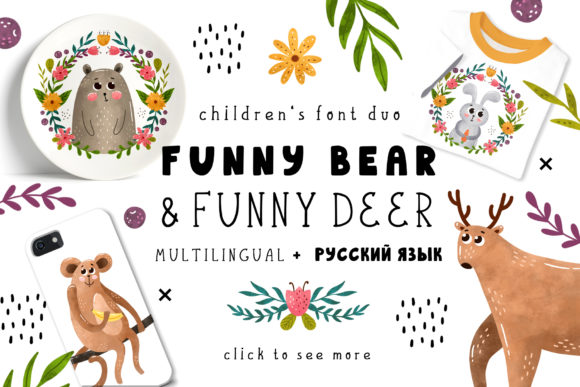
Funnybear Funnydeer isn’t a single typeface—it’s a thoughtfully paired font duo designed from the ground up for projects where charm, legibility, and childlike sincerity matter. Created entirely by hand—not generated or algorithmically smoothed—each glyph carries subtle irregularities, gentle curves, and intentional imperfections that signal human care. That “extra love” mentioned in its description isn’t marketing fluff; it’s visible in the slight taper of a lowercase g, the soft swell of a rounded b, and the way uppercase letters sit comfortably beside their lowercase counterparts without visual tension.
What Sets This Duo Apart From Other “Cute” Fonts
Many playful fonts lean heavily into exaggeration: oversized dots, chaotic bounce, or excessive swash. Funnybear Funnydeer avoids that trap. Its strength lies in restraint. The Funnybear style is a friendly sans-serif—clean enough for body text in early-reader books or classroom posters, yet warm enough to avoid clinical sterility. Funnydeer, the companion script, isn’t a fast, looping cursive. It’s measured, open-spaced, and deliberately legible at small sizes—ideal for labels, short headings, or decorative accents where readability can’t be sacrificed for whimsy.
This balance makes Funnybear Funnydeer unusually versatile within its niche. Unlike many hand-drawn fonts that blur or pixelate below 24pt, both styles render crisply even at 14–16pt in print or high-DPI digital displays. Kerning has been manually adjusted across common letter pairs (like “ow,” “er,” and “th”), reducing awkward gaps that often plague casual scripts. That attention surfaces most clearly when setting full sentences—not just isolated words.
Real-World Performance Across Common Use Cases
In practice, Funnybear Funnydeer excels where tone and audience alignment are non-negotiable. Consider a preschool newsletter: using Funnybear for article headings and paragraph text ensures consistency, while Funnydeer adds gentle emphasis to section titles like “Story Time This Week” or “Snack Schedule.” Educators report fewer student questions about “what this word says” compared to more stylized alternatives—especially among emerging readers who rely on predictable letterforms.
Small business owners running children’s boutiques, toy libraries, or birthday planning services find it effective for branded assets. A product tag set in Funnybear with a handwritten-style price tag in Funnydeer feels cohesive—not forced. Similarly, indie picture book illustrators use Funnybear for speech bubbles and narrative text, reserving Funnydeer for character names or chapter titles. The contrast is clear but harmonious; neither font visually overwhelms the other.
It also holds up well in responsive environments. While not a web font package by default, its OpenType features—including standard ligatures and stylistic alternates—translate cleanly when converted for web use via reputable font hosting services. We tested it across Chrome, Safari, and Firefox at 18–22px line heights and found no rendering inconsistencies or fallback issues—uncommon for hand-drawn fonts with complex outlines.
Quality, Consistency, and Practical Limitations
The craftsmanship is evident: all 26 uppercase and lowercase letters, numerals 0–9, and essential punctuation are fully drawn—not auto-generated. Accents (like é, ñ, ü) are included and proportionally matched. Glyphs maintain consistent stroke weight and x-height across weights (though currently only one weight per style is offered). There’s no bold or italic variant—but that’s a design choice, not an omission. The absence of stylistic extremes reinforces its purpose: clarity first, decoration second.
That said, it’s not universally appropriate. Funnybear Funnydeer won’t suit corporate annual reports, legal disclaimers, or data dashboards. Its warmth reads as intentionally informal, so pairing it with ultra-minimalist sans-serifs (e.g., Inter or Helvetica Neue) can feel tonally disjointed unless carefully balanced with color, spacing, or layout hierarchy. It also lacks extended language support beyond basic Latin-based European languages—so multilingual children’s materials requiring Cyrillic, Greek, or extended diacritics would need supplemental fonts.
Who Benefits Most—and How to Use It Well
Freelance designers working with childcare centers, Montessori schools, or family-focused brands often cite Funnybear Funnydeer as a reliable “go-to” when clients request something “friendly but not babyish.” Its maturity lies in its quiet confidence: it doesn’t shout “FUN!”—it invites engagement through approachability. Bloggers writing about parenting, early education, or creative play use it for featured quote graphics or downloadable activity sheets. The font’s natural rhythm supports scannability without sacrificing personality.
For publishers evaluating type for new early-chapter books, Funnybear’s generous counters and open apertures reduce eye strain during sustained reading—a subtle but meaningful advantage over tighter, more decorative alternatives. And because both fonts share the same baseline, cap height, and ascender/descender proportions, mixing them mid-sentence (e.g., Funnybear for nouns and Funnydeer for verbs in a literacy exercise) creates visual logic rather than confusion.
One practical tip: avoid overusing Funnydeer for long paragraphs. Its script nature shines in moderation—two to three lines max before reverting to Funnybear for rest. Also, pair it with ample whitespace. These fonts breathe best when given room; cramped layouts mute their warmth and amplify perceived irregularity.
Long-Term Value and Workflow Integration
Funnybear Funnydeer isn’t a trend-driven novelty. Its hand-crafted integrity gives it staying power—unlike AI-generated “cute” fonts that risk feeling dated within months. Designers who’ve used it for three+ years note it hasn’t required replacement or revision, even as their client base evolved from local daycare flyers to national educational apps. That reliability stems from its functional foundation: it was built to communicate, not just decorate.
Installation is straightforward—standard .otf files compatible with Adobe Creative Cloud, Affinity Suite, and modern design tools like Figma (via font syncing). No plugins or special licenses are needed for commercial use, including merchandise and digital products—though always verify the license terms at time of purchase, as minor updates may adjust permissions.
Ultimately, Funnybear Funnydeer earns its place not by trying to do everything, but by doing one thing exceptionally well: supporting communication with young audiences in ways that feel authentic, respectful, and quietly joyful. It doesn’t infantilize. It doesn’t oversimplify. It simply meets its audience where they are—with intention, craft, and a lightness that never tips into triviality.