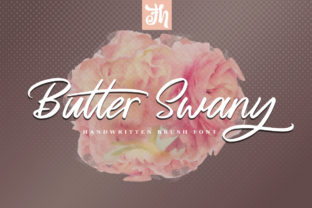
Butter Swany: A Playful Script Font for Expressive, Human-Centered Design
Butter Swany is a script font defined by its relaxed, hand-drawn rhythm and generous, playful curves. It doesn’t mimic formal calligraphy or tight brush lettering — instead, it leans into warmth, spontaneity, and gentle asymmetry. Each character flows with subtle variation in stroke weight and terminal shape, giving text a consistently organic, approachable feel. That distinct personality makes Butter Swany especially effective where authenticity and friendliness matter more than rigid precision.
What Sets Butter Swany Apart From Other Script Fonts
Many script fonts fall into one of two broad categories: tightly kerned, high-contrast styles meant for elegance (think engraved invitations), or energetic, bouncy fonts designed for youthful energy (common in kids’ branding). Butter Swany occupies a thoughtful middle ground. Its curves are soft but intentional; its spacing is open enough to ensure legibility at medium sizes without sacrificing flow. Unlike ultra-thin scripts that vanish at small sizes or overly dense ones that blur together, Butter Swany maintains clarity from 16px body text up to large display headings — provided line height and contrast are thoughtfully applied.
The lowercase a, g, and y feature distinctive, rounded exits that reinforce continuity between letters. There’s no sharp angle or abrupt stop — just smooth, unhurried transitions. This isn’t accidental; it reflects a deliberate design philosophy prioritizing ease of reading and emotional resonance over technical virtuosity. As a result, Butter Swany feels less like a decorative flourish and more like a voice — one that’s warm, unhurried, and quietly confident.
Where Butter Swany Fits in Real-World Use Cases
Butter Swany excels in contexts where tone and relatability drive engagement. It works well for brand names, product tags, short headlines, and editorial pull quotes — particularly in lifestyle, wellness, education, and creative services. For example, a small-batch bakery might use Butter Swany for its logo and menu headers, pairing it with a clean sans-serif for ingredients and pricing. A mindfulness app could apply it to onboarding screens or affirmation cards, where softness supports the message. In these cases, Butter Swany doesn’t shout — it invites.
It’s less suited for long-form body copy, legal disclaimers, data tables, or interfaces requiring rapid scanning. Its connected letters and variable spacing reduce efficiency when readers need to parse information quickly. Similarly, environments with low-resolution displays or constrained color contrast (e.g., light gray text on off-white backgrounds) can mute its charm and compromise readability. These aren’t flaws — they’re natural boundaries shaped by its design intent.
Comparing Butter Swany With Common Alternatives
When evaluating script fonts, designers often weigh tradeoffs between expressiveness and utility. Butter Swany differs meaningfully from several widely used options:
- Brush-style scripts (e.g., fonts mimicking paint or marker strokes) tend to emphasize texture and energy but can feel chaotic in structured layouts. Butter Swany trades that raw texture for consistency — making it more predictable across digital and print formats.
- Formal copperplate or Spencerian scripts carry strong historical associations and high contrast between thick and thin strokes. They signal tradition and formality — qualities that sit at odds with Butter Swany’s casual, contemporary ease.
- Monoline scripts (with uniform stroke weight) often prioritize simplicity and scalability but risk feeling generic or flat. Butter Swany introduces gentle modulation — not dramatic contrast, but enough variation to suggest human touch.
- Geometric or modular scripts rely on precise curves and symmetry. While highly legible, they sometimes lack warmth. Butter Swany’s slight irregularities — a slightly tilted baseline here, an extended loop there — add quiet humanity without sacrificing cohesion.
This isn’t about ranking “better” or “worse.” It’s about alignment. If your goal is to evoke craft, care, or calm — rather than authority, urgency, or novelty — Butter Swany offers a nuanced, grounded option.
Practical Considerations for Implementation
Butter Swany performs best when paired intentionally. Its friendly tone pairs naturally with neutral, open sans-serifs (like Inter, Lato, or Work Sans) — fonts that provide structure without competing for attention. Avoid pairing it with other decorative or high-contrast typefaces; the contrast should come from function, not ornament.
For web use, check whether the version you license includes OpenType features like contextual alternates or ligatures. These subtle variations help avoid repetitive patterns in longer words — for instance, ensuring that repeated os or ns don’t look identical. Also verify that the font file includes full Latin character support, including diacritics if your audience uses accented characters.
In responsive layouts, test Butter Swany at multiple breakpoints. Its curves hold up well on modern high-DPI screens, but on older mobile devices or in cramped containers (e.g., narrow email clients), consider using it only for larger elements — headlines, buttons, or hero text — while falling back to a robust system font for body content.
When Butter Swany Is the Right Choice — And When It Isn’t
Choose Butter Swany if:
- You’re designing for audiences that value approachability over polish — such as community-based organizations, independent educators, holistic health practitioners, or handmade goods brands.
- Your content emphasizes storytelling, reflection, or personal connection — think newsletters, workshop materials, or packaging that invites pause and presence.
- You have control over surrounding design elements (color, spacing, imagery) and can support its expressive nature without visual clutter.
Consider another option if:
- Your project demands strict accessibility compliance at small sizes (e.g., government forms or medical instructions), where consistent letterforms and generous x-heights are non-negotiable.
- You’re working within a brand system that already uses a strong, established typographic hierarchy — introducing Butter Swany may disrupt visual continuity unless carefully integrated.
- Technical constraints limit font loading (e.g., embedded systems, legacy CMS platforms), and you need lightweight, widely supported alternatives.
Making an Informed Decision
Selecting a script font like Butter Swany isn’t just about aesthetics — it’s about choosing how your message lands emotionally and functionally. Ask yourself: What feeling do I want readers to carry away? How much visual breathing room does this layout allow? Will this font support — or distract from — the core information?
Try setting real content in Butter Swany alongside your top alternatives. Read it aloud. Print it. View it on a phone held at arm’s length. Notice where your eye lingers, where it stumbles, where it relaxes. These small observations reveal more than any spec sheet.
Butter Swany won’t solve every typographic challenge. But for projects where gentleness, authenticity, and quiet confidence matter — where the goal isn’t to impress, but to connect — it offers something increasingly rare: a script font that feels both intentional and unstudied, polished yet human.