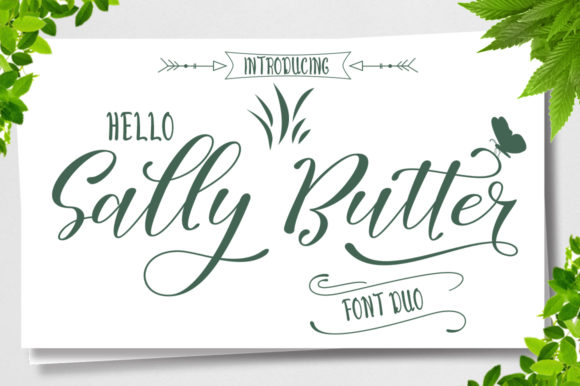
Sally Butter: A Feminine Font Duo for Elegant, Approachable Design
When you're crafting a brand identity, website, or print collateral that needs to feel warm, refined, and unmistakably human—Sally Butter often emerges as the quiet standout. Sally Butter is not a single font, but a thoughtfully paired duo: a graceful, hand-drawn script and a clean, friendly sans-serif companion. Together, they create visual harmony that feels both intentional and effortless—ideal for creatives, small business owners, and designers who want elegance without pretension.
Why Designers and Small Business Owners Reach for Sally Butter
Many professionals face the same design dilemma: how to communicate warmth and authenticity while maintaining professionalism and readability. Logos, packaging, wedding stationery, boutique websites, and social media graphics all need to resonate emotionally—but also function clearly across devices and contexts. Generic fonts can feel cold or overused; overly decorative scripts may sacrifice legibility or versatility. That’s where Sally Butter steps in—not as a trend-chaser, but as a practical solution rooted in balance.
The script half of Sally Butter features soft, flowing curves with subtle variation in stroke weight—giving it organic movement and personality. Its lowercase “s” and “y” have gentle flourishes, while its uppercase letters retain structure and presence. Paired with its sans-serif counterpart—designed to complement, not compete—it offers immediate contrast and hierarchy without visual tension. This duality makes Sally Butter especially valuable when you need both expressive voice (in headlines or logos) and dependable clarity (in body text or captions).
Real-World Uses Where Sally Butter Shines
Sally Butter works best when intention meets application. Here are several high-impact scenarios where it delivers measurable value:
- Small business branding: A local florist, ceramic studio, or holistic wellness practice can use the script for their logo or shop name—and the sans-serif for taglines, price tags, or service descriptions. The result feels personal, trustworthy, and memorable.
- Wedding and event design: Invitations, menus, and signage benefit from Sally Butter’s gentle rhythm. Unlike ultra-thin scripts that vanish on textured paper, Sally Butter maintains presence at medium sizes—even when printed on recycled or cotton-blend stock.
- Digital content with heart: Blog headers, email newsletter subject lines, or Instagram story text gain approachability with Sally Butter’s script—while body copy stays highly legible using the supporting sans-serif. It subtly signals care in communication, which builds connection with readers.
- Packaging for artisanal goods: Think handmade soap labels, small-batch tea tins, or candle boxes. Sally Butter adds tactile charm without overwhelming product photography or competing with natural materials.
What Makes Sally Butter More Than Just “Pretty”
Its strength lies in thoughtful design decisions—not just aesthetics. For example, the script includes OpenType features like contextual alternates and ligatures, allowing designers to fine-tune flow and avoid repetitive letterforms. The sans-serif has generous x-height and open counters, enhancing readability at smaller sizes—critical for mobile interfaces or fine-print details. Kerning between the two families is optimized, so pairing them doesn’t require manual tweaking to feel cohesive.
Importantly, Sally Butter avoids common pitfalls of feminine-leaning typefaces: it’s not overly delicate, cutesy, or constrained by gendered expectations. Its curves feel confident—not coy. Its spacing feels generous—not sparse. That nuance matters when building brands that appeal broadly while staying true to a specific voice.
Getting Started with Sally Butter: Practical Tips
If you’re considering Sally Butter for your next project, start with these actionable recommendations:
- Define your primary use case first. Will the script appear in a logo? As a headline font? For short quotes only? Limiting its role helps preserve impact and ensures the sans-serif carries necessary functional weight.
- Test contrast and hierarchy early. Try pairing Sally Butter’s script with its sans-serif at various sizes—especially on the devices your audience uses most. Does the headline draw attention without shouting? Does body text remain comfortable to read after three lines?
- Respect its rhythm. Sally Butter thrives with breathing room. Avoid tight tracking or excessive leading adjustments unless intentionally creating a distinct effect. Let its natural cadence guide spacing choices.
- Consider accessibility. While Sally Butter’s script isn’t intended for long-form reading, ensure all essential information (like contact details or instructions) appears in the sans-serif version—or in an accessible fallback font if used on the web.
Different Users, Different Approaches
How you apply Sally Butter depends on your tools, goals, and technical comfort:
- Non-designers (e.g., solopreneurs): Use Sally Butter in Canva or Adobe Express templates where pairing is pre-configured. Stick to title + subtitle layouts—avoid stacking multiple script elements. Focus on consistency: use the same size and color treatment across platforms.
- Graphic designers: Leverage OpenType features in Illustrator or InDesign for refined typographic control. Experiment with color overlays, subtle textures, or duotone effects that enhance—but don’t obscure—Sally Butter’s curves.
- Web developers: Embed Sally Butter via a reputable font service (like Google Fonts or Adobe Fonts) and always declare a system-font fallback for the sans-serif. Use
@font-facerules carefully to minimize render-blocking, and test loading behavior on slower connections.
A Final Thought: Elegance That Serves Purpose
Sally Butter endures because it answers a real need—not for decoration, but for resonance. In a digital landscape saturated with uniformity and algorithm-driven sameness, choosing a font with visible humanity matters. It tells your audience: *this was made with care. This reflects intention. This is meant for you.*
That’s why Sally Butter isn’t just another trending font duo. It’s a quietly powerful tool for anyone who believes design should uplift, clarify, and connect—not just occupy space. Whether you’re launching a new line of botanical skincare, redesigning a therapy practice’s website, or sending out heartfelt client thank-you notes, Sally Butter offers a foundation that’s both beautiful and deeply functional.
Start small. Try it in one high-visibility place—a logo lockup, a hero section headline, or a signature email footer. Notice how it shifts tone. Then build outward—always asking: *Does this serve the message? Does it welcome the reader? Does it reflect who we are—without saying a word?* With Sally Butter, the answer is often yes.