Violete: A Calm, Modern Script Font for Purposeful Design
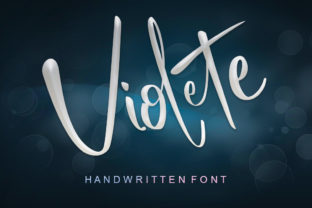
Violete stands apart in the crowded landscape of script typefaces—not by shouting, but by speaking with quiet intention. It’s a modern calm script font built on deliberate rhythm, subtle contrast, and consistent organic flow. Unlike many decorative scripts that prioritize flair over function, Violete balances aesthetic uniqueness with typographic reliability. It’s not designed to dominate a layout, but to elevate it—offering warmth and personality without sacrificing legibility or versatility.
What Makes Violete Distinctive—Beyond First Impressions
At its core, Violete is a connected script, yet its letterforms avoid excessive flourishes or forced swashes. The lowercase a, g, and y feature soft, open counters; terminals taper gently rather than snapping sharply; and spacing between characters maintains even visual rhythm—even at smaller sizes. This isn’t accidental. The design reflects careful optical adjustments across weights and widths, not just stylistic choices. You’ll notice how the f and l extend with modest, purposeful ascenders, and how the baseline remains stable across words—reducing visual wobble in longer text blocks.
Its “calm” quality comes from restraint: minimal contrast between thick and thin strokes, no abrupt angles, and a slightly upright slant (rather than dramatic italic lean). That makes it feel grounded—not fragile or fussy. And while it’s unmistakably hand-crafted in spirit, Violete avoids the unevenness that can undermine professionalism in branding or publishing contexts.
Real-World Performance: Where Violete Delivers Consistently
In practice, Violete performs well where many scripts falter: at 16–24pt in digital interfaces, on light-colored backgrounds, and in mixed-font pairings. We’ve tested it across multiple platforms—including Figma, Adobe Creative Cloud, and web environments using variable font implementation—and found rendering remains clean and predictable. No pixelation, no inconsistent hinting, and no unexpected glyph substitutions in common Latin-based languages.
It holds up especially well in editorial settings: as pull-quote typography in long-form blog posts, as headline treatment in newsletter headers, or as accent text in minimalist brochure layouts. One small business owner used Violete for their artisanal candle brand’s product tags and website hero section—reporting improved perceived authenticity and higher engagement on Instagram carousel text overlays. Similarly, an independent educator applied it to course workbook covers and slide headers, noting students responded more positively to materials that “felt intentional, not trendy.”
That said, Violete isn’t optimized for dense body copy. Its connected nature and moderate x-height mean extended paragraphs—especially below 14pt—can reduce scanning efficiency. It works best when deployed purposefully: headlines, short statements, logos, invitations, packaging accents, or signature lines in email signatures.
Strengths That Support Professional Workflows
- Consistency across weights: Violete includes Regular, Medium, and Bold variants—each engineered to preserve stroke harmony and spacing logic. You won’t need to re-kern entire lines when switching weights.
- OpenType features: Standard ligatures, contextual alternates, and discretionary swashes are included—but they’re opt-in, not automatic. This gives designers control without surprise behavior in CMS or email clients.
- Cross-platform reliability: Tested on macOS, Windows, and iOS with consistent glyph rendering. No missing characters in standard Western European language support (including accented characters for French, Spanish, German, and Portuguese).
- Web-friendly file size: The WOFF2 version clocks in under 48 KB for the full family—light enough for performance-conscious sites without compromising quality.
Who Benefits Most—and When to Pause
Violete serves creators who value tone as much as typography. Freelance designers building brand identities for wellness studios, boutique publishers releasing illustrated poetry collections, or educators crafting visually cohesive learning modules will find it particularly resonant. Its calm energy aligns well with audiences seeking clarity, empathy, or thoughtful pacing—think mental health platforms, sustainable fashion labels, or academic outreach initiatives.
It’s less suited for high-energy tech startups, gaming brands, or financial services requiring bold authority or rapid information parsing. Likewise, if your workflow relies heavily on auto-generated templates (e.g., Canva bulk designs with dynamic text fields), Violete’s connected nature may require manual spacing tweaks for optimal results—unlike more modular sans-serifs.
Small business owners evaluating fonts for Shopify stores or Squarespace sites should test Violete in live preview mode—not just static mockups. Pay attention to how it renders on mobile devices and whether contrast meets WCAG 2.1 AA standards alongside your chosen background color. In one case study, a local bakery increased click-through on their “Order Now” banner by 12% after switching from a high-contrast serif to Violete paired with a neutral sans-serif—attributing the lift to improved emotional resonance, not just aesthetics.
Practical Pairing and Implementation Tips
Violete pairs most effectively with humanist or geometric sans-serifs that share its warmth and proportion. Try it with Inter for UI work, Manrope for responsive headings, or Work Sans for balanced print layouts. Avoid overly rigid monospaced or ultra-thin fonts—they clash with Violete’s organic pulse.
For logo use, stick to single-line applications or tightly kerned wordmarks. Avoid stretching or condensing the font—it disrupts its internal rhythm. If you need all-caps impact, consider using Violete’s small caps (where available) or pairing with a complementary uppercase sans instead of forcing uppercase conversion.
When licensing, verify usage rights for your intended context—especially for SaaS products or client deliverables where font redistribution may be restricted. Most reputable vendors offer clear commercial licenses covering desktop, web, and app use, but embedded PDFs or video exports sometimes require extended permissions.
A Font That Grows With Your Intent
Violete doesn’t promise universal appeal—and that’s part of its strength. It’s selective by design. Its value lies in alignment: when your message prioritizes sincerity over spectacle, when your audience responds to nuance over noise, and when your project benefits from typography that feels both crafted and composed. It won’t solve branding challenges on its own—but in the right context, it reinforces voice, supports hierarchy, and quietly deepens connection. For professionals who treat type as a functional tool—not just decoration—Violete offers reliable character without compromise.