Balnes: Bold Script with Refined Soul
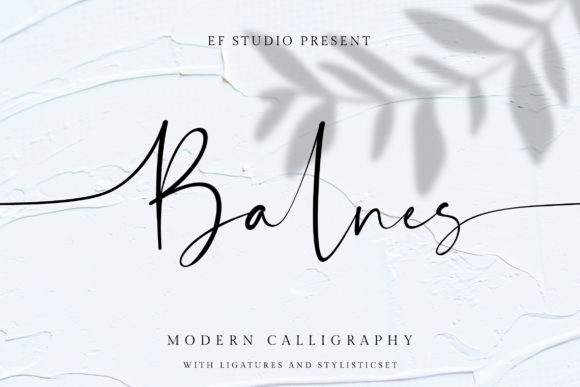
If you’ve ever scrolled past a wedding invitation, boutique packaging, or an artisan coffee bag and paused—just for a second—because the lettering felt *alive*, you’ve likely seen Balnes in action. It’s not just another script font. Balnes is a premium font that balances raw authenticity with refined control: elegant curves meet confident weight, delicate terminals carry quiet authority, and every glyph feels intentionally hand-drawn—not digitized or over-smoothed. It’s a modern typography choice that refuses to play it safe.
What Makes Balnes Stand Out Visually
Balnes is a display font first and foremost—a script font built for impact, not extended reading. Its structure leans into contrast: thick downstrokes anchor each character, while thin upstrokes lift the eye. That bold twist isn’t gimmicky; it’s functional. The weight gives Balnes presence on screen and in print without sacrificing legibility at medium sizes (think 24–48pt). Unlike many handwritten fonts that blur into visual noise, Balnes maintains clear spacing, consistent rhythm, and intentional exit strokes—making it feel both personal and professional.
The personality is unmistakable: warm but not cutesy, confident but not aggressive, artistic but not inaccessible. It reads as human-made, yes—but also carefully edited. That balance is rare. You’ll notice subtle asymmetries in the lowercase g and y, slight variations in swash endings, and a natural slant that avoids mechanical uniformity. These aren’t flaws—they’re cues your brain reads as sincerity.
Where Balnes Earns Its Place
This isn’t a font for body text—or for corporate slide decks where neutrality rules. Balnes shines where voice matters more than volume. Think: a small-batch skincare brand’s logo, a literary magazine’s cover title, a ceramicist’s product label, or an Instagram story announcing a limited-edition drop. In editorial design, it works beautifully for pull quotes or section headers—adding texture without overwhelming the layout.
In packaging design, Balnes adds tactile credibility. Print it on uncoated stock with soft ink bleed, and it reinforces craftsmanship. On a website banner? Pair it with a clean sans serif (like Inter or Manrope) for immediate contrast—and watch how quickly visitors grasp tone and intention. Social media graphics benefit too: a single-line headline in Balnes stands out in a feed saturated with generic sans serifs and overused slab fonts.
It’s equally effective in personal projects—say, a wedding suite or a handmade zine—where authenticity signals care. But don’t assume it’s only for “soft” industries. A tech consultancy launching a creative workshop series used Balnes for their event name, paired with a crisp monospace for details. The juxtaposition communicated approachability *and* precision—no explanation needed.
How It Shapes Perception—Without Saying a Word
Typeface choices quietly shape how people interpret your work. Balnes tells viewers: *This was made by someone who pays attention—not just to what’s said, but how it’s said.* That perception builds trust faster than any tagline. When used consistently across touchpoints—a business card, email header, and product tag—the font becomes part of your brand identity, reinforcing recognition through repetition and emotional resonance.
Readability here isn’t about scanning paragraphs—it’s about instant comprehension of hierarchy and intent. A headline in Balnes immediately signals importance. Its weight and flow guide the eye before the reader even processes meaning. And because it’s designed with real-world use in mind, it holds up well across devices: no awkward clipping on mobile, no fuzzy rendering on high-DPI screens—provided you serve it via modern web font loading practices.
Using Balnes Thoughtfully—Not Just Decoratively
Before dropping Balnes into your next project, ask two things: *Does this need personality?* and *Is there room for emphasis?* If your answer is “yes” to both, you’re on solid ground. Avoid using it for navigation menus, data tables, or multi-line testimonials. Reserve it for moments where you want attention, warmth, or distinction.
Test pairings early. Balnes pairs best with typefaces that offer structural counterbalance—so avoid other scripts or overly decorative fonts. A sturdy sans serif (with open counters and generous x-height) creates clarity. For print work, try it beside a classic serif like Adobe Garamond or a contemporary one like Crimson Text. In digital interfaces, ensure line-height and letter-spacing are adjusted so Balnes doesn’t crowd adjacent elements.
Check the included styles. Most Balnes licenses include regular, bold, and sometimes italic or alternate swash variants. Don’t default to bold for everything—use the regular weight for subtlety (e.g., a signature on a thank-you note), and save bold for primary branding moments. Also verify licensing: Balnes is a commercial font, and its license covers web, app, desktop, and print use—but always review the terms for your specific use case, especially if distributing templates or SaaS platforms.
A Few Real-World Notes from Practice
- Print tip: At small sizes (<14pt), Balnes loses its nuance. Use it for headlines, logos, or short phrases—not captions or fine print.
- Web tip: Load Balnes asynchronously and provide a system font fallback (e.g.,
"Balnes", "Segoe Script", cursive) to maintain hierarchy during load. - Brand tip: If your logo uses Balnes, extend that energy into secondary assets—not by repeating the font, but by echoing its rhythm in iconography, line work, or spacing patterns.
- Accessibility note: While Balnes itself isn’t WCAG-compliant for UI text, it meets standards when used decoratively or as non-essential branding—as long as critical information remains in accessible type.
Balnes doesn’t shout. It leans in. It invites closer look, slower reading, and quieter appreciation. That’s why designers reach for it when they want their work to resonate—not just register. Whether you’re refining a logo, designing a book cover, or building a cohesive social feed, Balnes offers something increasingly rare in digital spaces: handwriting that feels earned, not automated. It’s not about being different for difference’s sake. It’s about choosing a tool that helps your message land with honesty—and staying power.