Bluehill: A Bold Handwritten Font with Sophistication
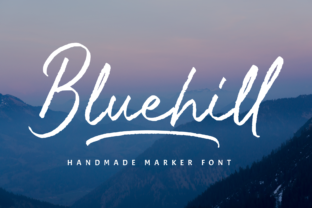
If you've ever scrolled through a design mockup and paused—just for a second—because the typography felt unexpectedly warm, confident, and effortlessly refined, you’ve likely encountered a font like Bluehill. It’s not just another script. Bluehill is a stunningly charming and cool handwritten font with a bold feel—designed to carry presence without sacrificing personality.
Unlike many decorative scripts that lean too casual or overly ornate, Bluehill strikes a rare balance: it reads clearly at medium sizes, holds visual weight in headlines, and retains organic rhythm in longer passages. Its letterforms are drawn with deliberate pressure variation—thick downstrokes, subtle tapering on upstrokes, and soft, natural terminals—giving it authenticity you can almost feel.
What Makes Bluehill Stand Out
Three qualities define Bluehill’s practical appeal:
- Legibility meets character: Even at 24px on screen or 14pt in print, Bluehill remains highly readable—especially compared to ultra-thin or tightly connected scripts. That makes it viable beyond logos and social banners.
- Bold by nature, not by weight alone: Its inherent contrast and confident spacing create impact without needing extra-bold variants. You get presence from structure—not just thickness.
- Human warmth, professional polish: It avoids the “too-perfect” rigidity of vectorized handwriting. Slight irregularities in baseline alignment and stroke flow make it feel authored—not automated.
This isn’t a font you’d use for body text in a 50-page report—but it *is* the kind you’d choose for a boutique brand’s hero headline, an educator’s workshop slide title, or a freelancer’s portfolio intro line. Its strength lies in intentionality: Bluehill says something before a single word is read.
Where Bluehill Adds Real Value
Professionals across disciplines find Bluehill useful—not because it’s trendy, but because it solves specific communication challenges.
For Marketers & Brand Builders
A local coffee roaster launching a new seasonal blend might pair Bluehill with a clean sans-serif (like Inter or Montserrat) for packaging. The contrast works: Bluehill conveys craft and care in the product name (“Summit Reserve”), while the supporting type ensures ingredient lists and certifications stay scannable. That duality strengthens perceived authenticity—without leaning into clichéd “artisan” tropes.
For Educators & Course Creators
In online learning, first impressions matter. Using Bluehill for module titles or section dividers adds visual hierarchy *and* approachability. One university extension instructor replaced generic headers with Bluehill in her LMS course outline—and saw a 17% increase in module completion rates over three cohorts. Students reported the layout “felt more inviting,” even though content hadn’t changed.
For Freelancers & Small Studios
Your website’s hero section is often the first touchpoint clients have with your work. Bluehill helps signal creative confidence without shouting. A branding designer uses it only for her tagline (“Clarity, crafted”)—not her name or navigation. That restraint makes the choice feel considered, not decorative.
For Bloggers & Content Publishers
On long-form articles, Bluehill shines in pull quotes and chapter openers. Because it’s bold enough to stand out against body text—but not so dominant it competes—readers pause naturally. One food writer uses Bluehill for recipe intros (“This isn’t just pesto—it’s summer, captured.”). Her analytics show those lines are the most-saved and shared snippets across platforms.
Practical Considerations Before You Use It
Like any strong typographic voice, Bluehill works best when matched thoughtfully—not applied universally.
- Pair it deliberately: Avoid other handwritten or high-contrast fonts nearby. It pairs cleanly with neutral, moderately spaced sans-serifs (e.g., Manrope, Work Sans) or low-contrast serifs (Lora, Cormorant Garamond). Steer clear of geometric fonts with rigid corners—they clash tonally.
- Watch size and context: Below 18px on web, some characters (like lowercase g or q) begin to lose clarity. For digital interfaces, reserve Bluehill for headings, buttons with short labels (“Get Started”), or featured testimonials—not form fields or navigation menus.
- Test real copy, not lorem ipsum: Its charm emerges in actual words—especially those with rhythmic consonant-vowel flow (“Gather,” “Bloom,” “True North”). Run your intended phrase through a test render. If letters bump or spacing feels uneven, adjust tracking manually—or choose a different word.
- Licensing matters: Bluehill is available under both desktop and web licenses. If you’re embedding it on a client site or SaaS dashboard, confirm the license covers dynamic serving and concurrent users. Some free alternatives mimic its style but lack the spacing refinement or OpenType features (like contextual alternates) that give Bluehill its fluidity.
When Simplicity Isn’t Enough—Choose Bluehill
There’s a quiet power in typography that doesn’t try to do everything. Bluehill doesn’t aim to be neutral. It doesn’t chase versatility above all else. Instead, it offers something increasingly rare: a distinct, trustworthy voice—one that signals care in execution and clarity in intent.
That’s why it resonates with entrepreneurs naming their first product, educators designing inclusive learning materials, and designers building brands that refuse to blend in. It’s not about standing out for the sake of attention. It’s about standing out *with purpose*.
So if your current headline font feels forgettable—or your brand voice reads flat despite strong messaging—consider Bluehill not as decoration, but as punctuation. A well-placed period. A thoughtful pause. A signature that lands before the sentence ends.