Sabendino: A Refined Handwritten Script for Elegant Typography
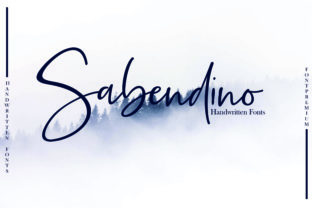
Sabendino is a carefully crafted handwritten script font distinguished by its delicate, flowing curves and consistent thin stroke weight. It avoids the exaggerated flourishes or dramatic contrast found in many display scripts, instead favoring subtle rhythm, balanced spacing, and quiet sophistication. This makes Sabendino less about attention-grabbing impact and more about adding understated refinement—ideal when visual tone matters as much as legibility.
What Sets Sabendino Apart from Other Script Fonts
Not all handwritten fonts serve the same purpose—or even the same audience. Sabendino occupies a specific niche: it’s neither a casual brush script nor a high-contrast copperplate revival. Its defining traits include:
- Consistent thin weight: No dramatic thick-to-thin transitions, which enhances readability at smaller sizes and lends cohesion across varied applications.
- Natural curve tension: Letters connect with gentle, organic flow—not rigidly joined, but thoughtfully guided—giving text movement without sacrificing clarity.
- Open counters and generous letter spacing: These features improve legibility in both digital interfaces and printed materials, especially at moderate sizes (14–24 pt).
- Subtle personality: It conveys warmth and craftsmanship without veering into whimsy or informality—making it adaptable across contexts where tone must remain polished but approachable.
This balance places Sabendino between two common categories: expressive, energetic scripts (often used for food branding or event invites) and formal, structured calligraphic fonts (favored for luxury stationery or certificates). Sabendino doesn’t try to do both—it excels where restraint and elegance are priorities.
Where Sabendino Fits—and Where It Doesn’t
Like any specialized tool, Sabendino performs best within certain boundaries. Its strengths become clearest when matched to appropriate use cases—and its limitations become equally apparent when mismatched.
Best-fit situations include:
- Editorial design: Pull quotes, chapter headings, or bylines in lifestyle magazines, literary journals, or thoughtful newsletters—where tone supports narrative depth rather than competing with it.
- Luxury or artisanal branding: Labels for small-batch skincare, boutique wine, or handmade ceramics—where authenticity and tactile sensibility matter, but overt ornamentation would feel disingenuous.
- Digital interfaces with intentional pacing: A portfolio site’s hero section, a wedding invitation suite, or an app onboarding screen where users linger rather than scan.
Less suitable scenarios include:
- Long-form body text: While legible at moderate sizes, Sabendino lacks the structural neutrality of serif or sans-serif typefaces designed for extended reading. Using it for paragraphs risks fatigue or reduced comprehension.
- High-contrast environments: On low-resolution screens, busy backgrounds, or under poor lighting, its fine strokes may blur or disappear. It benefits from ample white space and strong contrast with its background.
- Brands requiring bold differentiation or rapid recognition: If your goal is instant memorability through visual punch—like a tech startup logo or streetwear label—Sabendino’s subtlety may not deliver the necessary impact.
Practical Comparison: How Sabendino Stacks Up
Choosing a script font often involves weighing tradeoffs between expressiveness, versatility, and technical reliability. Sabendino’s design decisions reflect deliberate compromises that serve specific goals:
Compared to bolder, variable-weight scripts, Sabendino sacrifices dramatic emphasis—but gains consistency across weights and sizes. You won’t find bold or italic variants, because its character lies in uniformity. That means fewer stylistic options, but also fewer opportunities for visual inconsistency in multi-element layouts.
Against more decorative or illustrative scripts, Sabendino trades uniqueness for adaptability. A highly stylized font might stand out beautifully on a single poster—but struggle across a responsive website or multilingual content. Sabendino’s restrained form allows smoother translation across devices, languages (with Latin-based scripts), and formats—from email headers to engraved coasters.
When evaluated alongside traditional calligraphic fonts, Sabendino offers greater accessibility. Its simplified connections and open forms reduce cognitive load for readers unfamiliar with formal penmanship conventions. It doesn’t require decoding; it invites quiet appreciation.
Real-World Application: What Works—and What Requires Adjustment
A wedding invitation suite illustrates Sabendino’s practical value well. Used for names and dates—set against uncoated cotton paper with muted ink—it reinforces intimacy and care without shouting. Pair it with a neutral sans-serif (like Lato or Inter) for addresses and details, and the contrast feels intentional, not jarring.
But consider using Sabendino for a restaurant menu. At first glance, it seems fitting for a bistro emphasizing craft and seasonality. Yet in practice, cramped spacing, ambient lighting, or quick scanning can undermine its effect. In that context, a slightly more robust script—or even a refined serif—may communicate the same values while supporting usability.
Another example: a personal blog focused on slow living or mindful design. Sabendino works beautifully for post titles and section dividers. But if the blog includes frequent pull quotes or bilingual excerpts, test how it renders across browsers and devices. Some OpenType features (like contextual alternates) enhance its flow but may not activate reliably everywhere—especially in email clients or older CMS platforms.
Technical Considerations Beyond Aesthetics
Before committing to Sabendino, assess practical constraints:
- Licensing scope: Confirm whether your intended use—web embedding, app integration, merchandise printing—is covered. Some licenses restrict usage volume or commercial scale.
- Language support: Sabendino covers standard Latin characters, accented letters (é, ñ, ü), and common punctuation. It does not include Cyrillic, Greek, or extended diacritics—so multilingual projects require careful planning.
- Web performance: As a variable or OTF file, it may add modest weight to page loads. Consider subsetting if only a limited character set is needed, or using system fallbacks for non-critical elements.
- Accessibility: While visually graceful, Sabendino should never replace accessible type for primary navigation or body copy. Use it for decorative or hierarchical roles—not functional ones like form labels or error messages.
Making the Call: Is Sabendino Right for Your Project?
The question isn’t whether Sabendino is “good”—it’s whether its particular qualities align with your project’s functional and emotional requirements. Ask yourself:
- Does the project benefit from quiet confidence rather than bold statement?
- Will the font appear in contexts where fine detail remains visible and legible?
- Is there room in the layout—and in the brand voice—for subtlety to resonate?
- Do you have control over surrounding elements (color, spacing, supporting type) to let Sabendino breathe?
If most answers are yes, Sabendino likely enhances more than it complicates. If several are uncertain or no, it may be wiser to explore alternatives—perhaps a slightly sturdier script, a minimalist serif with handwritten-inspired italics, or even a carefully chosen sans-serif with humanist warmth.
Ultimately, Sabendino serves designers who value intention over impulse—who understand that elegance often lives in restraint, and that the right font doesn’t dominate a design, but completes it.