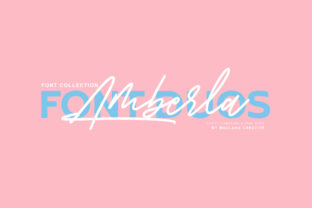
Amberla Duo: A Strategic Font Pair for Purpose-Driven Design
Amberla Duo isn’t just another font bundle—it’s a deliberately balanced pairing: a clean, confident sans-serif and an expressive, hand-informed script. Together, they form a visual dialogue that supports intentionality in design, not decoration. For professionals who make decisions daily—whether choosing a brand voice, crafting a pitch deck, or refining a customer-facing asset—Amberla Duo offers more than aesthetic appeal. It offers leverage.
Why Pairing Matters More Than Picking
Most designers spend time selecting *one* standout font. But Amberla Duo shifts the focus from selection to relationship: how two distinct typographic personalities interact to clarify meaning, guide attention, and reinforce hierarchy. The sans-serif carries authority and legibility; the script adds warmth, personality, and human rhythm. Used well, this contrast doesn’t compete—it complements. Used poorly, it confuses.
This duality mirrors real-world communication needs. A small business owner launching a new service doesn’t need uniformity—they need clarity *and* connection. A marketer building an email campaign must balance scannability with emotional resonance. An educator designing workshop materials must signal structure while inviting engagement. Amberla Duo meets those dual demands—if applied with purpose.
When Amberla Duo Delivers Strategic Value
Strategic value emerges where typography serves function—not just form. Consider these grounded use cases:
- Brand identity systems: Use the sans-serif for logos, navigation, and body copy (clarity, scalability), and the script for taglines, testimonials, or handwritten-style callouts (distinctiveness, memorability). This avoids over-reliance on script alone—which often fails at small sizes or in digital interfaces.
- Presentation decks: Apply the sans-serif for headlines, data labels, and speaker notes (readability under time pressure); reserve the script for section dividers or quote highlights (momentary emphasis without sacrificing flow).
- Social media visuals: Leverage the script for short, evocative phrases (“Just launched,” “You’re invited”) paired with the sans-serif for supporting context (“New course starts May 15”). This creates visual breathing room and directs the eye efficiently.
- Printed collateral: On business cards or letterhead, the sans-serif anchors professionalism; the script adds signature-level authenticity—especially effective when used sparingly in a monogram or closing line.
Notice what’s absent from this list: decorative banners, full-page script headlines, or forced pairings where neither font earns its place. Amberla Duo works best when each font has a defined role—not when both are competing for attention.
How to Approach Amberla Duo Intentionally
Start with your goal—not your layout. Ask: What action should the viewer take? What feeling should linger? What information must be retained? Only then does typography become a tool, not a temptation.
Begin with the sans-serif. Test it first in isolation: Does it hold up in body text at 14–16px? Does it remain legible against subtle backgrounds or in low-contrast settings? Its strength lies in reliability—not flair. If it stumbles here, Amberla Duo won’t compensate.
Then bring in the script—but only where variation adds value. Try it on a single word: a verb (“Create”), a noun (“Clarity”), or a proper name. Does it feel earned? Does it enhance meaning—or distract from it? Script fonts carry tonal weight; misused, they imply informality where seriousness is needed, or exclusivity where accessibility matters.
A practical planning tip: Build a simple style guide *before* designing. Define exactly where each font appears—and where it doesn’t. Example:
- Headlines: Sans-serif only
- Subheads: Sans-serif, bold, increased tracking
- Callout quotes: Script for attribution (“—Jamie T., Founder”), sans-serif for quote text
- Captions & footnotes: Sans-serif only, 12px
- Never use script for URLs, phone numbers, or legal disclaimers
This isn’t restriction—it’s discipline. And discipline scales: when you onboard a freelancer or hand off assets to a developer, clear rules prevent drift and preserve intent.
Risks of Using Amberla Duo Without Context
Typography without strategy invites inconsistency. The most common pitfalls aren’t technical—they’re perceptual and operational:
- Over-indexing on novelty: Choosing the script because it “feels creative” rather than because it advances a goal. Result: diminished credibility, especially in B2B or education contexts where clarity trumps charm.
- Ignoring medium constraints: Using the script in UI buttons or mobile menus where touch targets and rendering vary. What looks elegant on a desktop may vanish on iOS Safari.
- Underestimating cognitive load: Mixing fonts increases processing effort. If your audience is scanning quickly (e.g., landing pages, social feeds), too much contrast slows comprehension—even if both fonts are beautiful individually.
- Forgetting accessibility: Script fonts rarely meet WCAG contrast or readability standards for body text. Never rely on Amberla Duo’s script for anything users must read, decode, or act upon without assistance.
None of these risks stem from Amberla Duo itself—they arise from applying it without alignment to audience, platform, or outcome.
Long-Term Positioning: Beyond First Impressions
Brands and creators often optimize for immediate impact: the striking homepage, the viral Instagram post, the polished pitch. But Amberla Duo’s deeper value reveals itself over time—in consistency, recognition, and reduced decision fatigue.
Think of it as a quiet multiplier. When your team uses the same pairing across email signatures, slide templates, and printed brochures, visual coherence builds subconscious trust. When customers see the same thoughtful contrast in your newsletter subject line and your packaging, they register stability—not sameness.
That consistency also saves time. Instead of debating fonts for every new asset, teams default to a proven system. That’s not rigidity—that’s efficiency grounded in prior testing and intentional choice.
And because Amberla Duo avoids trend-driven extremes (no ultra-thin weights, no exaggerated flourishes), it ages gracefully. A 2024 brochure using it won’t look dated by 2027—not because it’s “timeless,” but because it was built for function first.
Making the Decision: Is Amberla Duo Right for Your Next Project?
Ask three questions before committing:
- Does my audience benefit from visual contrast—or do they need uniformity? Educators presenting complex frameworks may prioritize the sans-serif alone. A lifestyle brand launching a seasonal campaign may gain from the script’s expressive lift.
- Do I have the capacity to enforce usage guidelines? If your workflow involves multiple contributors without design oversight, start with the sans-serif only—and introduce the script only after establishing baseline consistency.
- What’s the cost of misalignment? If a misused script undermines perceived expertise (e.g., in financial services), defer its use until higher-stakes moments—like personalized thank-you notes or client onboarding kits—where warmth reinforces trust.
Amberla Duo doesn’t promise transformation. It enables precision. It rewards preparation. It responds to clarity of purpose—not volume of output.
Use it where contrast serves understanding. Reserve it where simplicity serves speed. And always let your goals—not the fonts—lead the way.