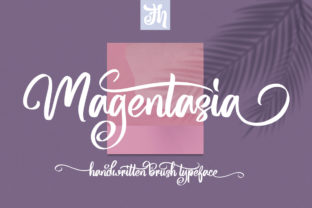
Magentasia: A Handwritten Font That Builds Connection—When Used With Purpose
Magentasia is more than a decorative typeface. It’s a handwritten font with expressive flourishes, rhythmic contrast, and subtle personality—designed not to shout, but to invite. Its letters carry warmth, intention, and human rhythm. That makes it uniquely suited for projects where authenticity, approachability, or emotional resonance matters—not just aesthetics.
Why Magentasia Fits Strategic Communication—Not Just Decoration
Many designers reach for handwritten fonts when they want “personality” or “uniqueness.” But Magentasia works best when those qualities serve a measurable goal: strengthening trust in a brand voice, softening the tone of an educational resource, or guiding attention in a hand-lettered invitation. Unlike overly casual scripts that blur readability or feel gimmicky at scale, Magentasia balances flourish with function. Its generous x-height, open counters, and consistent baseline keep it legible even at moderate sizes—especially important when used for headlines, short quotes, or callouts in digital interfaces or print collateral.
This isn’t about adding “charm” as an afterthought. It’s about aligning typography with intent. If your goal is to signal care in a wellness newsletter, Magentasia can reinforce that quietly—without needing illustrations or stock photos. If you’re launching a boutique service with high-touch positioning, using Magentasia in your welcome email signature or onboarding PDF subtly signals craftsmanship before a single word is read.
Where Magentasia Delivers Real Value—And Where It Doesn’t
Magentasia excels in controlled, intentional applications:
- Branded storytelling assets: Annual reports with illustrated chapter headers, founder-led video thumbnails, or printed workshop workbooks where visual tone supports narrative depth.
- Customer-facing touchpoints with emotional weight: Thank-you notes, limited-edition packaging, subscription box inserts, or personalized onboarding emails where warmth increases perceived value.
- Educational or creative resources: Printable planners, guided journal prompts, or downloadable worksheets where handwriting cues encourage reflection and reduce cognitive load.
- Local or artisanal branding: Cafés, independent bookshops, craft studios, or therapy practices where authenticity is part of the offering—not just the look.
It does not work well for body text, data-heavy dashboards, legal disclaimers, multilingual interfaces (especially with non-Latin scripts), or fast-scrolling social feeds where clarity must win every millisecond. Using Magentasia for navigation labels, pricing tables, or mobile app buttons risks undermining usability—and by extension, trust. That’s not a limitation of the font; it’s a mismatch of tool and task.
How to Decide—Before You Type a Single Letter
Ask three questions before selecting Magentasia:
- What outcome do I want this element to support? (e.g., “I want readers to pause and reflect on this quote,” not “I want it to look pretty.”)
- Who will encounter it—and under what conditions? (e.g., A parent reading a bedtime story PDF on a tablet vs. a developer scanning API documentation on a monitor.)
- Does Magentasia reinforce—or distract from—the message hierarchy? (If the most important information gets visually buried beneath flourish, reconsider spacing, size, or pairing.)
For example, a small business owner designing a holiday promo email might use Magentasia only for the subject line (“You’re invited—let’s celebrate together 🎁”) and the closing signature. The rest remains clean, functional sans-serif. That contrast directs attention without sacrificing scannability. It also creates a memorable tonal fingerprint—consistent enough to recognize, restrained enough to respect the reader’s time.
Pairing Magentasia Thoughtfully—Not Just Visually
Effective pairing isn’t about contrast for contrast’s sake. It’s about creating harmony between voice and structure. Magentasia pairs well with humanist sans-serifs like Inter, Lato, or Manrope—fonts that share its warmth and proportion but anchor the layout with neutrality. Avoid ultra-thin or geometric sans-serifs (like Montserrat Light or Helvetica Neue) unless you’re intentionally creating tension—and have a reason for it.
When setting Magentasia in print or high-DPI displays, increase letter-spacing slightly (5–10 units) to prevent flourishes from crowding. In web use, always define fallbacks and test rendering across Chrome, Safari, and Firefox—some browsers compress hinting in variable fonts, which can mute Magentasia’s subtler details.
Risks of Using Magentasia Without Strategy
The biggest risk isn’t poor legibility—it’s misaligned perception. When used without clear purpose, Magentasia can unintentionally signal informality in contexts requiring authority (e.g., financial advisories), inconsistency in brands built on precision (e.g., SaaS dashboards), or effortlessness where diligence matters (e.g., academic citations). Worse, overuse dilutes its impact: if every headline, button, and testimonial uses Magentasia, it stops feeling special and starts feeling arbitrary.
Another common pitfall: assuming Magentasia “solves” brand differentiation. A font alone doesn’t build recognition—it supports it. If your messaging, color system, or customer experience lacks cohesion, Magentasia won’t mask that gap. It may even highlight it, because its expressiveness draws attention to inconsistencies elsewhere.
Long-Term Use: Building Recognition Without Repetition Fatigue
Brands that sustain Magentasia successfully treat it as a *tonal accent*, not a default. Consider how The Skimm uses custom illustration and conversational voice—not a single font—to create consistency. Magentasia functions similarly: it’s one thread in a larger fabric of expression.
For long-term projects—like a multi-year content series or an evolving product suite—reserve Magentasia for moments that benefit from emphasis: launch announcements, milestone reflections, or community spotlights. Rotate its application: sometimes in headings, sometimes in pull quotes, sometimes as a watermark behind a clean layout. This maintains freshness while reinforcing familiarity.
Also consider licensing scope. Magentasia is often licensed per domain or per user. If you’re scaling usage across client work, internal tools, or white-labeled platforms, verify permissions early. Unexpected licensing gaps can delay launches or force last-minute redesigns—eroding the very trust Magentasia was meant to build.
Practical Planning Tips for Teams and Solo Creators
- Start with one use case. Pick a single recurring asset—like email headers or workshop handouts—and apply Magentasia there consistently for 90 days. Measure engagement (open rates, time-on-page, feedback) before expanding.
- Create a micro-style guide. Define exactly where Magentasia appears, at what sizes, with what spacing, and paired with which secondary font. Even two sentences prevent drift across team members or contractors.
- Test with real users—not just peers. Show two versions of a landing page: one with Magentasia in the headline, one without. Ask, “What do you expect this page to be about?” and “How would you describe the tone?” Their answers reveal whether Magentasia is supporting—or distorting—your intent.
- Review quarterly. Revisit where Magentasia appears. Has usage expanded without strategy? Has audience or platform changed (e.g., more mobile traffic)? Adjust before habits harden.
Magentasia isn’t a shortcut to connection. It’s a tool that rewards attention—to context, audience, and outcome. When chosen deliberately, it deepens resonance. When applied reflexively, it adds noise. The difference lies not in the font itself, but in how clearly you’ve defined what you’re trying to achieve—and whether Magentasia helps get you there.