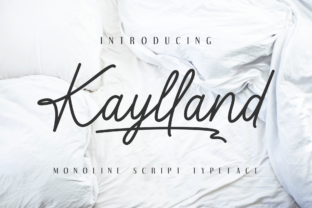
Kaylland: A Handwritten Font That Balances Personality and Professionalism
Kaylland is a carefully crafted handwritten typeface that avoids the pitfalls common to script fonts—namely, excessive ornamentation, inconsistent spacing, or illegibility at smaller sizes. It’s not a novelty font designed for one-off social media posts; rather, it’s built for sustained use across branding systems, editorial layouts, and digital interfaces where authenticity and clarity both matter. Its appeal lies in its quiet confidence: it feels human without sacrificing structure, expressive without becoming distracting.
What Sets Kaylland Apart From Other Handwritten Fonts
Many handwritten fonts prioritize flair over function—swashes that clash, letterforms that vary unpredictably, or kerning that breaks down outside of display sizes. Kaylland takes a different approach. Its lowercase letters feature subtle variation in stroke weight and terminal shape, but maintain consistent x-height, baseline alignment, and rhythm. Uppercase characters are purposefully restrained—not overly decorative, yet distinct enough to anchor headings or logos. The result is a font that reads as organic, not algorithmically randomized.
The design includes standard OpenType features like ligatures and contextual alternates, but they’re applied judiciously. For example, the “fi” and “fl” ligatures improve flow without altering meaning or legibility. Optional swashes exist, but only on select capitals (like “Q,” “Y,” and “Z”)—not forced into every word. This restraint supports readability in longer text blocks, such as email newsletters or blog intros, where many script fonts falter.
Real-World Performance Across Mediums
In practice, Kaylland performs well across formats—print, web, and mobile—but with important caveats. At 16–20px on screen, it remains legible for short headlines or callouts, especially against high-contrast backgrounds. However, it’s not suited for body text at small sizes (below 14px) or low-resolution displays, where fine strokes begin to blur or disappear. Print applications—letterhead, packaging, or illustrated book covers—showcase its strengths most clearly, particularly when paired with a clean sans serif for contrast.
One practical observation: Kaylland scales predictably. Unlike some handwritten fonts that lose character at larger sizes (becoming cartoonish or overly dense), Kaylland retains its warmth and proportion from 24px up to 120px+ in print. Designers working on signage, event posters, or Instagram carousel headers report consistent results—no last-minute manual adjustments needed to balance spacing or weight.
Who Benefits Most—and When
Kaylland serves professionals who need to convey approachability without compromising credibility. Educators crafting course materials or workshop handouts find it effective for titles and section dividers—adding visual warmth while keeping content scannable. Small business owners in wellness, creative services, or boutique retail use it in brand identities where personality matters: think yoga studios, independent bookshops, or artisanal food brands. It works because it signals care and craft—not trend-chasing.
Freelancers and marketers also benefit, particularly when developing cohesive visual systems for clients. Because Kaylland has a clear voice but isn’t overly stylized, it integrates smoothly with supporting typefaces—often pairing well with neutral sans serifs like Inter, Poppins, or Lato. That flexibility means it can anchor a brand without demanding full typographic overhaul.
Bloggers and content creators use Kaylland selectively: for newsletter subject lines, featured quote graphics, or podcast episode titles. Its tone sits comfortably between friendly and focused—more grounded than bubbly, more intentional than casual. It doesn’t scream for attention; it invites closer reading.
Quality, Consistency, and Technical Reliability
The font files are well-structured and include full Latin character sets, basic diacritics, and standard punctuation. It supports Western European languages out of the box and handles basic OpenType features reliably across modern design tools (Figma, Adobe Creative Cloud, Affinity Suite). Webfont versions load efficiently, with variable weight options limited to regular and bold—sufficient for hierarchy without bloating page weight.
Consistency is where Kaylland stands out. Letters don’t wobble unnaturally across words; ascenders and descenders align cleanly; spacing between “a” and “v,” or “r” and “o,” feels intentional, not arbitrary. That consistency translates directly into reduced revision time—fewer manual kerning passes, fewer client requests to “fix the spacing.” For teams managing shared design systems, this reliability reduces friction during handoff and implementation.
Practical Considerations and Limitations
Kaylland isn’t a universal solution. It doesn’t replace a workhorse sans serif for UI text, data tables, or legal disclaimers. Its handwritten nature makes it unsuitable for contexts requiring strict neutrality—think financial dashboards, technical documentation, or government forms. Likewise, it lacks extended language support (e.g., Cyrillic, Greek, or East Asian scripts), so global-facing projects may require fallback strategies.
Another realistic note: Kaylland’s strength is in moderation. Overuse dilutes impact. A landing page with Kaylland for headlines, subheads, buttons, and testimonials quickly feels overwhelming—not charming. Best practice is to limit it to one or two strategic roles per layout: perhaps logo + pull quotes, or headline + CTA button. Let it breathe.
How to Use Kaylland Effectively in Your Workflow
Start by defining its role before opening your design file. Ask: Is this for recognition (logo), emphasis (headline), or texture (accent element)? Then choose size and color deliberately. Dark charcoal or deep navy on light backgrounds preserves clarity; avoid very light grays or pastels unless testing at actual output size.
Pair it intentionally. Avoid other script fonts nearby—competing energy creates visual noise. Instead, use a geometric or humanist sans serif with open counters and generous letter spacing. Test combinations at multiple sizes: what works at 48px on a banner may collapse at 18px in an email preview pane.
If licensing for web use, confirm whether your plan covers dynamic serving (e.g., via Google Fonts or self-hosted CSS). Some versions require separate web licenses, and performance varies depending on how the font is loaded and cached.
Long-Term Value and Audience Alignment
Fonts age—some feel dated within months, others remain useful for years. Kaylland’s design avoids time-sensitive flourishes, favoring timeless proportions and balanced contrast. That contributes to longevity in brand assets: a logo using Kaylland today won’t require rebranding next year just to stay current.
Its audience alignment is precise. It resonates with viewers who value sincerity over slickness—people responding to messages about craftsmanship, mindfulness, or personal connection. That makes it less effective for audiences prioritizing speed, authority, or technical precision (e.g., enterprise SaaS buyers or academic journals), but highly effective for those seeking resonance over rigidity.
In summary, Kaylland earns its place not through novelty, but through thoughtful execution. It delivers what it promises: a beautiful, smart handwritten font with a cool feel—one that enhances rather than overrides the message. Whether you’re refining a brand identity, designing a product launch, or simply choosing a font that reflects your voice more accurately, Kaylland offers a rare balance: human enough to connect, structured enough to last.