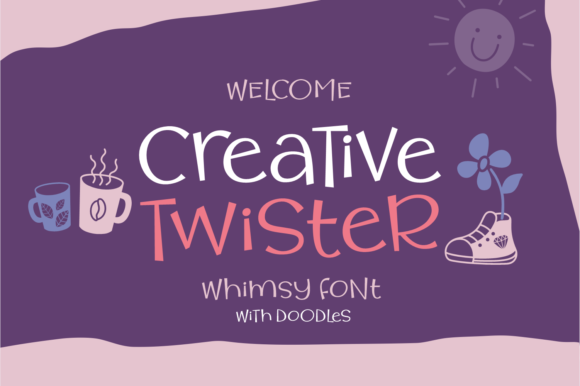
Creative Twister: A Handwritten Serif That Bridges Personality and Professionalism
Designers, marketers, educators, and small business owners increasingly face a quiet but persistent tension: how to stand out without seeming unpolished, and how to feel human without sacrificing credibility. Creative Twister answers that question—not with a compromise, but with intention. It’s a handwritten serif font with a whimsical twist, grounded in typographic structure yet animated by expressive rhythm and organic variation. Its defining feature isn’t just the letterforms—it’s the integrated set of hand-drawn doodles: tiny stars, looping vines, playful arrows, ink blots, and delicate flourishes—all designed to harmonize with the font’s weight, slant, and spacing.
Why Handwritten Serifs Are Resonating Now—More Than Ever
Over the past five years, we’ve seen a measurable shift away from ultra-minimalist, rigid sans-serifs in brand expression—especially among service-based businesses, learning platforms, creative studios, and community-driven initiatives. This isn’t nostalgia; it’s responsiveness. Users today don’t just scan—they pause for warmth, authenticity, and visual texture. A 2023 Adobe Creative Cloud survey found that 68% of designers reported clients requesting “approachable but not childish” typography for digital campaigns, packaging, and educational materials. That sweet spot—where craftsmanship meets charm—is exactly where Creative Twister lives.
Unlike many script fonts that prioritize flourish over function, Creative Twister maintains strong x-heights, clear ascenders and descenders, and consistent stroke contrast. That means it works at 14pt in an email footer or 72pt on a workshop poster—without losing legibility or intent. Its serif foundation gives it structural trustworthiness, while its handwritten quality adds voice. The result? A typeface that feels like it was made *for* people, not just *by* them.
More Than Just Letters: How the Doodles Change the Game
The doodles included with Creative Twister aren’t decorative afterthoughts. They’re functional design elements—carefully calibrated to scale, weight, and rhythm alongside the characters. You’ll find them as standalone icons, as bullet alternatives, as section dividers, or subtly embedded in headlines (think a tiny leaf curling around the tail of a “y” or a dot replaced with a miniature sun).
This integration matters because it reduces design friction. Instead of hunting across three different icon sets or manually sketching accents, you get cohesive, stylistically unified visual language in one package. A freelance educator building a printable workbook can use the pencil doodle as a subtle activity marker. A boutique coffee roaster launching seasonal packaging might pair the swirl doodle with hand-lettered flavor notes. A nonprofit running a youth literacy campaign could use the star and book doodles to reinforce themes without relying on stock imagery.
Crucially, these elements avoid cliché. There’s no forced “kiddie” aesthetic—no wobbly outlines or exaggerated bounce. The line work is confident, slightly uneven (as real ink would be), and always proportionally aware. That realism builds E-E-A-T—experience, expertise, authoritativeness, and trustworthiness—without saying a word.
Fitting Into Real Workflows—Not Just Mockups
Creative Twister performs well across tools and contexts used daily by professionals. It’s OpenType-enabled, supporting ligatures, stylistic alternates, and contextual swashes—so designers using Illustrator, Affinity Designer, or Figma can access nuanced variations with minimal effort. For non-designers, it works cleanly in Canva (uploaded as a custom font) and Google Docs (via browser extensions), making it accessible to teachers crafting lesson slides or solopreneurs updating their website banners.
One practical observation: users report faster iteration when Creative Twister is part of their toolkit. Because the doodles are native to the font file—not separate SVGs—they resize, recolor, and align predictably. No more mismatched line weights between text and icon. No more pixelated exports. That consistency saves time during client revisions and internal alignment, especially when multiple team members contribute to visual assets.
Evolving Expectations—and How Creative Twister Meets Them
Five years ago, “handwritten” often meant “casual.” Today, it signals intentionality. Audiences recognize that choosing a bespoke handwritten serif—especially one with built-in illustration logic—reflects care about tone, audience resonance, and visual storytelling discipline. Platforms like Instagram and TikTok reward personality, but algorithms also favor clarity and cohesion. Creative Twister delivers both: expressive enough to stop a scroll, structured enough to support readability in fast-moving feeds.
This evolution mirrors broader shifts in branding strategy. Brands no longer default to “trust through uniformity.” They build trust through consistency *with character*. Consider how Duolingo’s illustrated voice or Mailchimp’s friendly-yet-precise interface succeeded—not by being cute, but by being reliably, recognizably themselves. Creative Twister supports that same principle: it doesn’t shout personality; it embodies it quietly, consistently, and with craft.
Practical Ways to Use Creative Twister—Without Overdoing It
Like any expressive tool, Creative Twister shines brightest when applied with restraint and purpose. Here’s what works in practice:
- Headlines with subtle doodle accents: Replace standard punctuation (like colons or dashes) with a matching doodle—e.g., a gentle curve instead of an em dash in a blog title.
- Interactive elements: Use the arrow or pointing-hand doodle in email CTAs or button labels—not as decoration, but as intuitive visual cue.
- Printed collateral with tactile appeal: Pair Creative Twister with uncoated paper stock. The slight tooth of the paper echoes the ink-on-paper feel built into the font’s design.
- Educational visuals: Teachers use the numbered doodles (1–10) alongside step-by-step instructions—replacing generic bullets with friendly, memorable markers.
- Brand voice reinforcement: If your brand voice is “thoughtful but warm,” use Creative Twister for quotes in newsletters—not for body copy, but for carefully chosen pull-outs that reflect your perspective.
Avoid common pitfalls: setting full paragraphs in Creative Twister (it’s optimized for impact, not endurance), layering too many doodles in one composition (three intentional placements beat ten scattered ones), or stretching the font beyond its natural width range (which disrupts its organic balance).
Looking Ahead—Without Chasing Trends
Creative Twister isn’t built for fleeting trends. It’s built for longevity—through thoughtful design decisions that anticipate how tools, platforms, and expectations continue to converge. As AI-generated visuals flood feeds, hand-crafted nuance gains value—not as novelty, but as differentiation rooted in human judgment. As remote collaboration becomes standard, shared visual language (like a consistent doodle system across a team’s presentations and docs) fosters cohesion without rigid templates.
What’s next isn’t about adding more features—it’s about deepening utility. Designers are already adapting Creative Twister for motion graphics (animating doodles frame-by-frame), accessibility overlays (using high-contrast doodle variants for low-vision users), and even AR experiences (projecting animated doodles alongside printed materials). These uses aren’t speculative; they’re emerging organically from how practitioners are already integrating the font into layered, multi-channel work.
In short, Creative Twister succeeds because it respects both the craft of typography and the reality of modern creation: tight deadlines, diverse audiences, evolving platforms, and the enduring human need for connection—even in the smallest details of a comma or a curl.