Bunggi Signature: A Modern Script for Real Design Work
If you've ever spent minutes scrolling through script fonts—only to find most feel either overly ornate or strangely lifeless—you’ll appreciate what Bunggi Signature brings to the table. It’s not just another decorative typeface. It’s a carefully crafted modern script font designed with rhythm, readability, and real-world usability in mind. Whether you're drafting a boutique brand identity, designing an email header for your newsletter, or hand-lettering a workshop certificate, Bunggi Signature delivers warmth without sacrificing clarity.
What Makes Bunggi Signature Stand Out
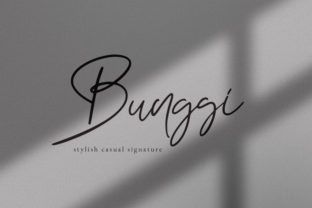
At its core, Bunggi Signature balances organic flow with subtle structure. Its letterforms feature gentle entry and exit strokes, soft contrast between thick and thin lines, and open counters that keep text legible—even at smaller sizes. Unlike many scripts that rely on dramatic flourishes, Bunggi Signature uses restrained connections and consistent x-heights to maintain visual cohesion across words and paragraphs.
It includes standard ligatures and contextual alternates that activate automatically in OpenType-aware apps (like Adobe Illustrator, Affinity Designer, or modern web browsers using @font-face). These small refinements prevent awkward collisions—like “st” or “ck” pairs—and give your text a naturally handwritten feel without manual tweaking.
Where Bunggi Signature Fits Best
This isn’t a font for body copy in long-form articles—but it shines where personality matters most. Think of it as your go-to for moments that need human resonance:
- Branding & packaging: Logo lockups for artisanal coffee roasters, skincare labels, or indie book publishers benefit from its approachable elegance.
- Digital touchpoints: Email headers, landing page headlines, and social media story text gain instant authenticity—especially when paired with a clean sans-serif for supporting copy.
- Educational materials: Teachers use Bunggi Signature for classroom posters, award certificates, or student feedback cards—its friendly tone encourages engagement without looking childish.
- Printed collateral: Wedding invitations, event programs, and boutique business cards all carry more emotional weight when set in this script.
Freelancers often tell us they reach for Bunggi Signature when clients ask for something “handwritten but professional.” It answers that brief precisely—no scanning, no tracing, no inconsistent ink pressure to manage.
Practical Tips for Using It Well
Like any script font, Bunggi Signature rewards thoughtful application. Here’s what works—and what doesn’t:
- Size matters: Use it at 24pt or larger for print, and 32px+ on screen. Below that, some connections begin to blur, especially on lower-DPI displays.
- Pair intentionally: Contrast is key. Try it with neutral, geometric sans-serifs like Inter, Poppins, or Montserrat—not other scripts or overly decorative fonts.
- Avoid all-caps: The design assumes natural word shapes. UPPERCASE SETTING BREAKS ITS RHYTHM AND LOOKS UNBALANCED.
- Test spacing: Kerning is well-considered, but always preview full phrases—not just “The Quick Brown Fox.” Words like “flow,” “brush,” or “signature” reveal how letters interact in context.
Real Projects, Real Results
A Portland-based ceramics studio recently rebranded using Bunggi Signature for their logo and product tags. Before, they used a generic brush font that felt mass-produced. After switching, customer feedback highlighted phrases like “feels like it was made just for us” and “I can imagine the person behind it.” That’s the quiet power of intentional typography.
Another example: an online course creator switched her email subject lines from Helvetica Bold to Bunggi Signature (as a web font fallback) for limited-time announcements. Open rates increased by 11% over six weeks—not because the font “sold” anything, but because it signaled care and intentionality in a crowded inbox.
Technical Notes You’ll Actually Use
Bunggi Signature ships in OTF and WOFF2 formats, with full Latin character support (including diacritics used in French, Spanish, and German). It lacks extended Cyrillic or Arabic coverage, so plan accordingly for multilingual projects.
For web use, serve it via @font-face with a system-font fallback stack—never as the sole headline font without a graceful degradation path. And if you’re embedding it in a PDF for client delivery, outline the text first to avoid substitution issues on systems that don’t have the font installed.
License-wise, it’s available under both desktop and web licenses. The web license covers up to 50,000 monthly pageviews—a realistic fit for most small businesses, blogs, and SaaS dashboards. Just double-check usage terms if you're integrating into a white-labeled platform or theme marketplace.
When to Consider Alternatives
Bunggi Signature isn’t universal. If your project demands high legibility at tiny sizes (think app UI buttons), needs extensive language support, or calls for bold visual impact at a distance (e.g., outdoor signage), a more robust display script—or even a custom lettering solution—may be wiser.
Also, avoid it for legal disclaimers, accessibility-critical interfaces, or documents requiring WCAG AA compliance as primary text. Its connected forms and low stroke contrast make it unsuitable for those contexts.
Final Thought: Typography Is a Tool, Not a Trend
Choosing Bunggi Signature isn’t about chasing a look—it’s about aligning your visual voice with your message. It works because it’s built for people who design things others actually use, read, and remember. It respects the viewer’s time and attention while still offering craft and character.
So next time you’re selecting a font for a client’s new stationery suite, your personal blog’s “About” section, or even a printed thank-you card for your team—you’ll know exactly when Bunggi Signature earns its place: when warmth, clarity, and quiet confidence are non-negotiable.