Soul Strokes
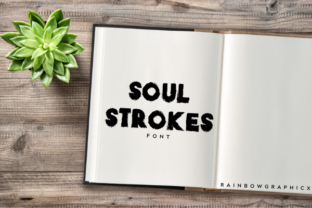
Soul Strokes is a bold, all-caps slab serif typeface designed for high visual impact. Its defining traits include thick, uniform strokes; pronounced serifs with squared or slightly tapered ends; tightly kerned letterforms; and a deliberate lack of lowercase characters. Unlike many display fonts that rely on ornamentation or irregularity, Soul Strokes achieves presence through structural confidence—weight, rhythm, and unapologetic geometry.
Why Consider Soul Strokes?
Designers and developers often seek typefaces that communicate strength, clarity, or authority without relying on imagery or layout tricks. Soul Strokes appeals in contexts where typographic presence must carry meaning on its own: exhibition signage, branding systems for mission-driven organizations, editorial headlines, or interface elements requiring immediate recognition. Its all-caps constraint isn’t a limitation—it’s a design directive that encourages intentional hierarchy and purposeful use.
Interest in Soul Strokes typically arises when users need a font that performs well at large sizes, supports short-form messaging, and resists visual fatigue under demanding conditions (e.g., outdoor installations, projected presentations, or high-contrast digital banners). It also attracts those prioritizing typographic consistency across touchpoints—since it lacks lowercase variants, stylistic drift across applications is reduced by design.
Key Benefits
- Strong legibility at scale: The slab serif structure and generous x-height support readability from distance or on low-resolution surfaces.
- Distinctive voice: Its rigid geometry and absence of modulation give Soul Strokes a consistent, unwavering tone—useful for brands emphasizing reliability or conviction.
- Reduced typographic decision fatigue: With no lowercase, italic, or condensed variants, implementation is simplified—especially in fast-turnaround or template-driven workflows.
- Cross-medium resilience: Performs reliably in print, environmental graphics, and digital displays where fine detail may be lost.
Tradeoffs and Practical Considerations
Soul Strokes is not built for extended reading. Its monolithic weight and lack of letterform variation make it unsuitable for body text, captions, or interfaces requiring nuanced information density. Using it for paragraphs, data tables, or multi-line navigation labels risks compromising usability and accessibility—particularly for readers with visual impairments or cognitive processing differences.
Another consideration is licensing and technical integration. As a display-oriented font, Soul Strokes may not be available through standard web font services or bundled with common design toolkits. Users should verify format support (WOFF2, variable axes, etc.), embedding permissions, and fallback strategies before committing to it in production environments.
Also note: its all-caps nature affects linguistic conventions. Acronyms, proper nouns, and initialisms render identically to full words—so “USA” and “USAID” appear visually indistinguishable without spacing or sizing adjustments. This matters in contexts where semantic distinction supports comprehension (e.g., legal documents or technical documentation).
When Soul Strokes Is a Strong Fit
Soul Strokes excels in focused, high-intent applications. It works well for:
- Branding systems anchored in clarity and resolve—such as advocacy campaigns, civic initiatives, or institutional identities where gravitas matters more than flexibility.
- Environmental signage in public spaces (museums, transit hubs, campuses) where durability, scale, and instant recognition outweigh typographic nuance.
- Editorial cover treatments or section headers in print or digital magazines—especially when paired with a neutral, highly readable text face.
- Interactive elements with limited real estate and high action priority, like call-to-action buttons or status indicators in dashboards.
When Alternatives May Be More Appropriate
If your project requires typographic versatility—multiple weights, optical sizes, language support beyond Latin scripts, or responsive behavior across devices—Soul Strokes will likely fall short. Fonts like IBM Plex Serif, Source Serif Pro, or STIX Two Text offer broader functional range while retaining slab serif character.
For digital-first projects emphasizing accessibility compliance (WCAG AA/AAA), consider typefaces with tested contrast ratios, OpenType features for dynamic scaling, and robust hinting. Soul Strokes lacks built-in optical sizing or variable weight axes, limiting adaptability in fluid layouts.
Projects involving multilingual content—including diacritics, non-Latin scripts, or complex ligature requirements—should prioritize fonts with comprehensive glyph sets. Soul Strokes is typically limited to basic Latin uppercase, making it impractical for global or inclusive deployments without supplemental type choices.
Making an Informed Choice
Evaluating Soul Strokes isn’t about whether it’s “good”—it’s about whether its constraints align with your functional and expressive goals. Ask yourself:
- Is the primary use case visual impact—not information density?
- Will the text remain short, intentional, and contextually supported (e.g., paired with imagery or explanatory copy)?
- Do stakeholders value consistency and strength over adaptability or subtlety?
- Are technical and licensing requirements compatible with your delivery pipeline?
If most answers are “yes,” Soul Strokes warrants serious testing—not just as a static sample, but within real layouts, at intended sizes, and across target devices. Preview it alongside your chosen text typeface to assess contrast, rhythm, and tonal cohesion.
Conversely, if your work involves long-form content, frequent typographic variation, or strict accessibility mandates, prioritize fonts engineered for those conditions—even if they lack the immediate visual force of Soul Strokes. Strength in typography isn’t only about weight; it’s about appropriateness, sustainability, and service to the reader.
Ultimately, Soul Strokes serves a specific role: the declarative voice. When used deliberately, it reinforces intent. When applied broadly or without context, it can obscure meaning. Its value lies not in universality, but in precision.