Roberts Hunter: Natural Handwriting, Refined
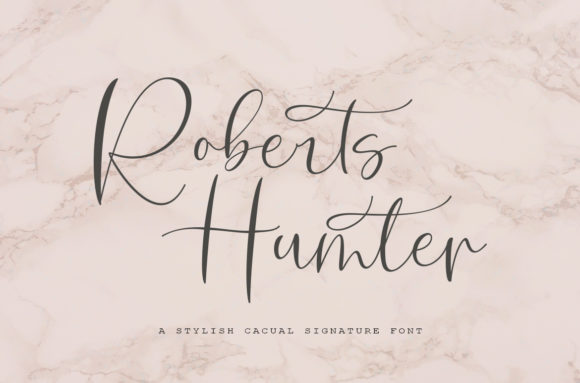
If you've ever spent too long scrolling through script fonts—only to land on something overly ornate, stiff, or digitally perfect—you’ll recognize the relief Roberts Hunter delivers. It’s not just another calligraphy font. It’s a carefully crafted digital interpretation of authentic pen-on-paper movement: subtle pressure variation, organic line endings, and gentle inconsistencies that signal human intention—not algorithmic repetition.
What Makes Roberts Hunter Stand Out
Roberts Hunter was designed with restraint in mind. Unlike many modern calligraphy fonts that lean into dramatic swashes or exaggerated flourishes, it prioritizes legibility without sacrificing character. Its lowercase ‘a’, ‘g’, and ‘y’ feature soft, open forms—not tight loops or sharp angles—that invite reading rather than admiration alone. The uppercase letters carry presence but avoid dominance; they complement rather than compete.
The rhythm feels intuitive. Letter spacing is generous but not airy, word spacing is consistent yet breathing, and baseline alignment stays grounded—no floating ascenders or sinking descenders. That balance makes Roberts Hunter work equally well at 14pt in a newsletter sidebar or 72pt as a wedding suite headline.
It includes standard OpenType features like contextual alternates and ligatures—but they’re subtle. A lowercase ‘f’ followed by ‘i’ doesn’t trigger a flashy connected glyph; instead, it adjusts micro-spacing for smoother visual flow. That kind of thoughtful engineering means Roberts Hunter performs reliably across platforms: web browsers, design apps (Figma, Illustrator, Affinity), and even some CMS editors with basic font support.
Where It Fits—And Where It Doesn’t
Roberts Hunter shines where warmth, authenticity, and approachability matter most. Think invitation suites, boutique packaging, educator newsletters, podcast cover art, or small-business social posts. A yoga studio using Roberts Hunter for their monthly class schedule instantly communicates care and craft—without saying a word about “mindfulness” in the copy.
It’s also highly effective in hybrid environments. Pair it with a clean sans-serif like Inter or Manrope for contrast that feels intentional, not accidental. Use Roberts Hunter for headlines and short pull quotes; let the sans-serif handle body text and captions. This pairing works especially well in digital learning modules—where tone impacts retention—and in email campaigns where first impressions happen in under three seconds.
That said, Roberts Hunter isn’t built for dense interfaces or data-heavy dashboards. Its charm lies in brevity and emphasis—not scanning rows of metrics or navigating nested menus. Avoid using it for legal disclaimers, accessibility labels, or anything requiring rapid parsing. If your audience needs to act quickly or compare fine details, reach for a functional typeface instead.
Real Projects, Real Results
- A freelance illustrator used Roberts Hunter for client-facing mood boards—replacing generic script previews with hand-crafted project titles. Feedback shifted from “Looks nice” to “This feels like *us*.”
- An independent publisher applied it to chapter title pages in a memoir collection. Readers reported stronger emotional connection to early chapters—likely because the font subtly echoed the author’s handwritten journal entries featured inside.
- A local coffee roaster printed Roberts Hunter on kraft paper bags alongside minimalist icons. Shelf presence improved noticeably in regional markets—shoppers paused longer, and staff reported more questions about “the story behind the font.”
None of these wins came from novelty alone. They emerged because Roberts Hunter supported voice—not overrode it. It didn’t distract from content; it deepened context.
Practical Tips Before You Commit
Before licensing Roberts Hunter, test it in your actual workflow—not just a specimen page. Drop it into your email template editor, paste it into your CMS preview mode, or generate a quick Figma mockup with real copy lengths. Watch how it behaves at different weights (if available) and sizes. Some users find the light weight loses clarity below 20px on screen; others prefer the regular weight for print but switch to semi-bold for large-format signage.
Also consider language support. Roberts Hunter covers Latin-based languages thoroughly—including extended diacritics for French, Spanish, Portuguese, and Scandinavian use—but doesn’t include Cyrillic, Greek, or Arabic glyphs. If your audience spans multilingual regions, verify coverage before finalizing brand guidelines.
Licensing is straightforward: desktop, web, and app usage are typically covered under standard commercial licenses. But if you're embedding Roberts Hunter into a SaaS product or white-labeled platform, double-check the EULA. Some foundries treat that as extended use—even if it’s internal-facing.
Pairing Without Overthinking
You don’t need a font pairing system to make Roberts Hunter sing. Start simple:
- Use it solo for short, high-impact text—like a tagline on a business card or a quote overlay on Instagram.
- Add a neutral sans-serif (e.g., Lato, Source Sans Pro, or even system fonts like -apple-system) for supporting text. Keep hierarchy clear: Roberts Hunter = voice, sans-serif = information.
- Resist adding a third font. Three typefaces rarely improve readability—they usually dilute focus.
And remember: consistency matters more than complexity. One well-chosen weight of Roberts Hunter, applied deliberately across touchpoints, builds recognition faster than rotating five different scripts hoping one “feels right.”
Final Thought: Tools Serve Tone
Typography isn’t decoration—it’s tonal infrastructure. Roberts Hunter works because it carries intention without shouting. It suggests care, not perfection. Craft, not control. When your goal is to connect—not impress—this font quietly does the work so your message doesn’t get lost in the noise.
Whether you’re drafting a heartfelt thank-you note, launching a new course landing page, or redesigning your studio’s stationery, Roberts Hunter offers a rare blend: expressive enough to stand out, grounded enough to stay readable, and human enough to feel true.