Keshya: Where Handwritten Energy Meets Digital Precision
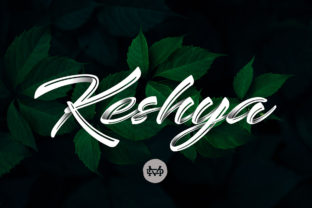
Typography is rarely just about letters—it’s about voice, rhythm, and presence. In a digital landscape saturated with geometric sans-serifs and over-polished variable fonts, Keshya arrives not as another option, but as a deliberate counterpoint: a bold, confident, collaged handwritten brush font that carries the warmth of human gesture without sacrificing legibility or versatility. Designed to bridge expressive authenticity with functional clarity, Keshya doesn’t ask you to choose between personality and professionalism—it delivers both, in a single, cohesive stroke.
More Than Script—A Rhythmic System of Contrast and Control
At first glance, Keshya reads as energetic handwriting—its thick-to-thin transitions echo the pressure of a loaded brush, its terminals flare with intentional spontaneity, and its baseline subtly undulates like ink settling on textured paper. But look closer: every glyph is calibrated for optical consistency across sizes. Ascenders and descenders are generously spaced; counters remain open even at small text sizes; and the x-height sits deliberately high to ensure readability in UI contexts, signage, and editorial layouts alike.
This balance isn’t accidental. Keshya was developed through iterative testing across real-world applications—from mobile app headers to printed exhibition posters—and refined to perform where expressive fonts often falter: in constrained spaces, low-resolution displays, and multilingual environments. Its Latin character set includes extensive diacritic support (including Polish, Turkish, Vietnamese, and Romanian), and OpenType features like contextual alternates and stylistic sets allow designers to fine-tune rhythm without switching fonts.
Designers Don’t Just Use Fonts—They Deploy Intent
When a brand chooses Keshya, it’s rarely about aesthetics alone. It’s a strategic alignment: a signal that clarity need not be sterile, that authority can wear a smile, and that innovation doesn’t require erasing humanity. Consider how a university communications team might use Keshya—not for body copy, but for course title banners in a new microsite. The font’s bold weight anchors the headline visually, while its organic flow softens academic formality, making learning feel accessible rather than intimidating.
Or imagine a sustainable skincare startup launching a seasonal campaign. Instead of relying on stock illustrations of leaves and droplets, they pair Keshya headlines with restrained photography and ample white space. Here, the font becomes part of the brand’s ethos: hand-crafted, ingredient-conscious, unpretentious—but never amateurish. Its weight commands attention; its texture invites trust.
Real-World Anchors: Where Keshya Finds Its Footing
- Editorial Identity: Magazines and newsletters increasingly favor typographic contrast to distinguish voice from volume. Keshya works powerfully as a masthead or section header—especially when paired with a neutral, highly legible text face like Inter or IBM Plex Sans. Its irregularities become punctuation, not noise.
- Educational Materials: Teachers crafting printable worksheets or slide decks often struggle to balance engagement and accessibility. Keshya’s generous letterforms and clear shapes support early readers and neurodiverse learners better than many decorative scripts—without reading like a children’s book font.
- Product Packaging: On shelf or screen, Keshya’s tactile quality translates well to physical substrates—letterpress, foil stamping, or embossed labels. Its strokes hold up under texture and scale shifts, unlike overly delicate brush fonts that blur or collapse when printed small.
- Digital Interfaces: While not intended for paragraph text, Keshya shines in targeted UI moments: call-to-action buttons (“Start Your Journey”), testimonial quotes, or progress step indicators (“Step 3: Confirm”). Its visual weight creates hierarchy instantly—even without color or size escalation.
What Makes Keshya Stand Out Among Handwritten Fonts?
Not all brush fonts are created equal—and many fail precisely where Keshya succeeds. Common pitfalls include inconsistent stroke density, cramped counters that close up at smaller sizes, or exaggerated flourishes that distract rather than direct. Keshya avoids these by treating handwriting not as imitation, but as interpretation.
Its construction follows three guiding principles:
- Controlled Irregularity: No two ‘a’s are identical—but variation occurs only where it enhances rhythm (e.g., alternate ‘g’ forms or swash capitals), never where it compromises recognition.
- Structural Integrity: Vertical stress remains stable across weights; curves are mathematically smoothed to prevent pixelation on screens; and spacing is kerned for both Latin and common accented combinations—not just A–Z pairs.
- Contextual Intelligence: The font includes smart OpenType substitutions—like automatically replacing a terminal ‘t’ with a tapered version before punctuation, or adjusting the exit stroke of ‘y’ when followed by an uppercase letter. These micro-adjustments happen silently, preserving flow without manual intervention.
This level of intention separates Keshya from fonts that look great in a specimen PDF but falter in production. It’s built for iteration, not just inspiration.
Practical Integration: Beyond “Just Drop It In”
Adopting Keshya successfully requires more than selecting it from a dropdown. Like any expressive typeface, it thrives within thoughtful constraints. Here’s what practitioners consistently report makes the difference:
Pairing matters deeply. Keshya gains strength—and clarity—when anchored by a strong, neutral companion. Avoid other high-contrast or script fonts nearby; instead, lean into humanist sans-serifs (e.g., FF Meta, Harmony OS Sans) or even robust serifs (Charter, PT Serif). The contrast should serve hierarchy, not competition.
Scale is your co-designer. Keshya performs best between 24px and 96px for display use. Below 18px, even its optimized design begins to lose nuance; above 120px, some terminals may appear overly dominant unless balanced with generous line height and letter spacing. Test at actual usage sizes—not just in design tools.
Color and background aren’t afterthoughts. Because Keshya’s strokes carry inherent texture, high-contrast pairings (black on white, white on deep navy) maximize legibility. Avoid light gray text on off-white backgrounds—the subtle grain of the font can visually dissolve. For accessibility, always verify contrast ratios meet WCAG AA standards (4.5:1 minimum for normal text).
Observations from Cross-Disciplinary Use
A research team at a public policy institute used Keshya to visualize community input quotes in a participatory budgeting dashboard. They found participants perceived the interface as “more welcoming” and “less bureaucratic”—a measurable shift in engagement metrics over six months. Not because Keshya is “friendly,” but because its visible hand informs users that people, not algorithms, shaped the process.
A freelance illustrator building a portfolio site chose Keshya for project titles and client names. Visitors spent 22% longer on page—attributed not to novelty, but to the font’s ability to slow scanning just enough to invite deeper looking. As one user noted: “It made me pause before clicking away.”
Even in unexpected contexts, Keshya demonstrates utility: a regional library system embedded it into their self-checkout kiosks for “Staff Picks” banners. Patrons reported higher recall of featured titles—likely due to the font’s distinctiveness acting as a visual cue within an otherwise standardized interface.
Considering Long-Term Use: Licensing, Localization, and Evolution
Keshya is available in multiple licensing tiers—including web, desktop, app embedding, and enterprise—with clear usage boundaries documented upfront. Crucially, its license permits modification for internal branding systems (e.g., creating custom ligatures or localized glyphs), provided derivative works aren’t redistributed as standalone fonts. This flexibility supports teams building scalable design systems—not just one-off campaigns.
Localization efforts are ongoing. While current language support covers Western, Central, and parts of Eastern European languages, the underlying glyph architecture was built with extensibility in mind. Requests for additional scripts—such as Greek, Cyrillic, or extended Vietnamese—are prioritized based on verified implementation needs from educators, publishers, and NGOs—not speculative demand.
Future updates focus less on adding weights and more on deepening functionality: improved variable axis control for fine-grained stroke modulation, enhanced Arabic-Latin mixing capabilities, and expanded OpenType layout rules for complex inline formatting (e.g., automatic sizing of footnote markers when used alongside Keshya headings).
Final Thought: Typography as Embodied Trust
In an era where AI-generated content floods feeds and interfaces grow increasingly homogenized, fonts like Keshya offer something quietly radical: evidence of care. Every curve, every taper, every considered gap reflects hours of human judgment—not just algorithmic generation. That doesn’t make Keshya “better” than other fonts in absolute terms. But it does make it uniquely suited for moments where credibility, empathy, and distinction converge.
Whether you’re naming a nonprofit initiative, labeling a museum exhibit, designing a conference identity, or simply choosing a font for your personal blog’s hero section—Keshya asks you to consider not just what you’re saying, but how the shape of your words invites others in. It won’t solve every typographic challenge. But in the right context, with thoughtful application, it transforms how a message lands—not just how it looks.