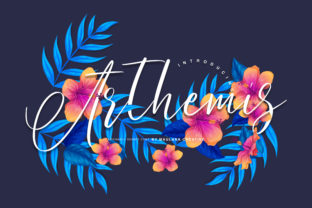
Arthemis: Where Handwritten Charm Meets Bold Design Impact
Imagine a font that doesn’t just sit on the page—but leans in, commands attention, and leaves a lasting impression. That’s Arthemis. It’s not another delicate script meant for wedding invites alone. Nor is it a rigid, mechanical sans-serif built for spreadsheets. Arthemis lives boldly in the middle: a stunning handwritten font with unmistakable presence, crafted to elevate real-world design work—not just decorate it.
More Than Just “Handwritten”—It’s Intentionally Expressive
Many fonts labeled “handwritten” lean too soft, too fragile, or too inconsistent for professional use. Arthemis breaks that mold. Its letterforms carry the warmth and rhythm of human handwriting—notice the subtle variation in stroke weight, the confident entry and exit strokes, the slight tilt that suggests motion and energy—but every character remains highly legible and structurally balanced.
This isn’t accidental charm. Each glyph in Arthemis was refined to support both personality and practicality. Uppercase letters have strong vertical emphasis and generous x-heights. Lowercase characters flow with natural connectivity—but never at the cost of readability. Even numerals and punctuation retain that same bold, grounded feel. The result? A font that feels personal without sacrificing professionalism.
Where Arthemis Truly Shines: Real Projects, Real Results
You don’t choose Arthemis for theory—you choose it because it solves visual problems. Here’s where it consistently delivers:
- Brand Identity Systems: When startups or creative studios want to signal authenticity *and* confidence—think artisanal coffee roasters, boutique fitness studios, or independent book publishers—Arthemis becomes the cornerstone of their logo, wordmark, or primary display type. It conveys craftsmanship without pretension.
- Digital Campaigns & Social Graphics: On Instagram carousels, email headers, or landing page banners, Arthemis stops scrollers mid-swipe. Its boldness ensures impact even at smaller sizes (down to ~36px), while its organic texture adds depth missing from overused system fonts.
- Packaging & Print Collateral: From soap labels to limited-edition vinyl sleeves, Arthemis brings tactile appeal to physical products. Paired with clean sans-serifs for body copy, it creates hierarchy that feels intentional—not forced.
- Presentation Slides & Keynotes: Presenters using Arthemis for titles or pull quotes report stronger audience engagement. The font’s expressive nature subtly reinforces speaker confidence and narrative warmth—without needing extra animation or effects.
Why Designers Reach for Arthemis Instead of Alternatives
Let’s be honest: the market is full of script fonts. So why does Arthemis stand out in actual workflows?
First, it scales well. Unlike many handwritten fonts that blur or collapse when resized, Arthemis maintains clarity across formats—from mobile app splash screens to large-format outdoor signage. Its robust outlines and open counters prevent visual crowding, even in tight layouts.
Second, it pairs intuitively. You won’t spend hours testing dozens of combinations. Arthemis works effortlessly with modern, neutral sans-serifs like Inter, Poppins, or Montserrat—especially in Regular or Medium weights. The contrast between its expressive curves and their clean geometry creates instant visual harmony. Bonus: it also holds its own alongside serif companions like Lora or Playfair Display when a more editorial tone is needed.
Third, it supports real language needs. Arthemis includes full Latin-1 and Latin Extended-A character sets, covering accented characters used across Western European languages. That means designers working with Spanish, French, Portuguese, or German clients can deploy it confidently—no last-minute substitutions or awkward workarounds.
Practical Considerations Before You Use Arthemis
Like any powerful tool, Arthemis works best when matched to the right context. Here’s what thoughtful users keep in mind:
- Use it for emphasis—not exposition. Arthemis is a display font. Reserve it for headlines, logos, callouts, and short impactful phrases. Avoid long paragraphs or dense UI text. Your readers—and your message—will thank you.
- Check licensing early. While Arthemis is available in multiple weights (Regular, Bold, and often an Italic variant), usage rights vary by vendor. If you’re embedding it in a SaaS dashboard, selling branded merchandise, or licensing a client’s final files, verify whether your license covers those scenarios. Most reputable sellers offer clear web, desktop, and app licenses—just read the fine print.
- Test contrast and accessibility. Its bold nature helps legibility, but background choices matter. Avoid placing Arthemis over busy photos or low-contrast gradients. For WCAG compliance, pair it with backgrounds offering at least a 4.5:1 contrast ratio—especially for smaller uses like captions or buttons.
- Consider rendering across devices. While Arthemis performs beautifully on macOS and modern Windows systems, older Android versions or legacy email clients may substitute fallbacks. Always preview in target environments—or use web font services with smart loading and graceful degradation.
How Arthemis Fits Into Today’s Creative Workflow
Modern design isn’t about isolated assets—it’s about cohesive, adaptable systems. Arthemis integrates smoothly into current tools and practices:
- Figma & Adobe XD: Available as a cloud font or via plugin import, Arthemis syncs across team libraries. Designers set up auto-layout components with Arthemis headings, then hand off to developers with precise specs—including recommended line heights and tracking values.
- Web Development: Hosted via Google Fonts (if available) or self-hosted via @font-face, Arthemis loads efficiently with proper subsetting. Developers appreciate its clean OpenType features—like standard ligatures and discretionary swashes—that enhance typographic polish without bloating file size.
- Marketing Automation: Platforms like Mailchimp and HubSpot support custom fonts in branded templates. With Arthemis, marketing teams maintain consistent voice across newsletters, promo banners, and social ads—reinforcing brand recognition with every send.
A Font That Grows With Your Project
What makes Arthemis especially valuable over time is its versatility across growth stages. A solo creator launching a personal brand might start with Arthemis for their logo and Instagram bio—then scale it seamlessly into a Shopify store banner, podcast cover art, and printed business cards. As their audience expands, Arthemis retains its distinctiveness without feeling “small-time.” It adapts—not by changing shape, but by holding space with quiet authority.
That’s rare. Many expressive fonts age poorly as brands mature. Arthemis avoids that trap by grounding its personality in structural integrity. It’s warm, yes—but never cutesy. Confident, yes—but never cold. Human, yes—but always intentional.
Final Thought: Choose Arthemis When You Want to Be Remembered
In a world saturated with generic templates and algorithm-driven design, standing out isn’t about being louder—it’s about being more meaningfully present. Arthemis gives designers and brands that edge: the ability to communicate craft, sincerity, and strength—all in a single line of text. It doesn’t shout. It resonates.
So whether you’re refining a startup’s visual identity, designing a campaign that needs emotional pull, or simply tired of fonts that vanish into the background—Arthemis is ready to turn your next project into a true standout.