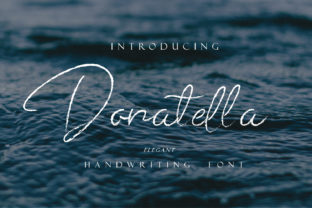
Donatella Font: Where Sophistication Meets Playful Curves
Fonts don’t just convey words—they shape mood, build trust, and whisper tone before a single sentence is read. Among the growing library of contemporary typefaces, Donatella stands out not for being loud or overly technical, but for its rare ability to shift character like a chameleon in silk: elegant at a gala, relaxed at a café, and delightfully whimsical on a children’s book cover. It’s not one font—it’s a family with personality, unified by something unmistakable: lovely curves.
A Typeface That Breathes With Context
What makes Donatella truly versatile isn’t just its range of weights or stylistic alternates—it’s how naturally it adapts to intention. Pair its light, airy italic with soft pastel branding, and it feels quietly luxurious. Switch to the bold, slightly expanded caps in all-caps headlines, and it gains confidence—ideal for boutique packaging or editorial mastheads. Use the rounded, open counters in a playful display weight for an app interface or school newsletter, and suddenly it feels warm, inclusive, and human.
This adaptability isn’t accidental. Every curve in Donatella was drawn with optical balance in mind—not just geometric precision, but how the eye rests on it across sizes and surfaces. The terminals taper gently. The bowls swell just enough to invite attention without shouting. Even the spacing between letters (kerning) has been fine-tuned for rhythm, so body text flows smoothly on screen and in print.
Why Designers Reach for Donatella First
- Brand identity systems that need flexibility—think lifestyle brands launching both a premium skincare line and a joyful wellness podcast. One font family handles both, keeping visual continuity without monotony.
- Digital products where readability meets charm. Unlike rigid neo-grotesques, Donatella’s generous x-height and open apertures make small UI text legible—even on low-DPI screens—while its curves soften the digital edge.
- Publishing projects that straddle genres: a memoir blending poetic reflection and candid humor, or a design magazine balancing critical essays with vibrant visual features. Donatella’s expressive range supports tonal shifts without requiring multiple fonts.
It’s also remarkably efficient in real-world workflows. Because its weights scale cohesively—from Hairline to Black, with matching italics and small caps—the designer avoids the common pitfall of “font bloat”: juggling five unrelated families just to cover headings, captions, pull quotes, and buttons. With Donatella, you get typographic hierarchy built-in.
Curves That Carry Meaning
Let’s talk about those curves—because they’re not decorative flourishes. In Donatella, curvature is functional language.
The lowercase a and e have softly closed bowls, lending warmth and approachability. The uppercase S flows in a continuous, unbroken stroke—no sharp transitions—making it ideal for monograms or logos where fluidity signals creativity or care. Even punctuation benefits: the question mark’s tail curls upward with gentle optimism; the ampersand leans into its own history while feeling freshly drawn.
These details matter most when context demands emotional resonance. A mental health app using Donatella Light in its onboarding flow feels supportive, not clinical. A wedding invitation set in Donatella Display evokes handwritten intimacy—without sacrificing polish. And yes, even data dashboards gain subtle humanity when labels and tooltips use Donatella Regular: clarity stays intact, but coldness recedes.
Real Projects, Real Results
Consider a recent rebrand for Marlowe Collective, a sustainable home goods brand. Their old typography felt stiff—too corporate for hand-thrown ceramics and organic linen. They switched to Donatella Medium for product descriptions and Donatella Bold Italic for seasonal campaign headlines. Customer feedback noted the site “felt more like a conversation”—a direct result of Donatella’s open, breathing letterforms.
Or take Stella Labs, a science education startup for middle-schoolers. Their curriculum materials needed to demystify complex topics without dumbing them down. Using Donatella Rounded for diagrams and callouts—and Donatella Text for explanations—created visual scaffolding: friendly enough to lower anxiety, structured enough to support learning. Teachers reported students spent more time engaging with written content, not just videos.
Practical Considerations Before You Commit
Like any powerful tool, Donatella shines brightest when matched thoughtfully to your needs. Here’s what to weigh:
- Licensing scope: Donatella offers web, desktop, and app licenses—each with clear usage boundaries. If you’re embedding it in a SaaS dashboard used by thousands, verify the web font plan includes dynamic serving and auto-scaling. Some designers overlook this until launch day.
- Language support: The standard release covers Latin-based languages extensively—including Vietnamese diacritics and extended Central/Eastern European characters. If you need Greek, Cyrillic, or Arabic support, check whether the foundry offers extended versions (some do, as optional add-ons).
- Performance on mobile: Donatella’s web fonts are well-optimized, but loading all 12 weights at once can delay render. Best practice? Load only the weights you’ll actually use (e.g., Regular + Bold for body, Display Bold for hero headers), and leverage
font-display: swapfor graceful fallbacks. - Pairing potential: While Donatella works beautifully solo, it pairs exceptionally well with clean, neutral sans-serifs (like Inter or Manrope) for contrast in editorial layouts—or with restrained serifs (such as Literata) when you want quiet sophistication without competition.
And one gentle reminder: Donatella thrives when given room to breathe. Tight tracking or excessive letter-spacing flattens its charm. Let those curves live. Use generous line-heights in paragraphs. Respect its natural rhythm.
More Than a Trend—A Typographic Ally
Trends come and go—ultra-thin fonts, chaotic variable axes, retro pixel styles—but Donatella endures because it answers a deeper need: the desire for type that feels human first. Not sterile. Not gimmicky. Not exhausting to read. Just consistently thoughtful, visually generous, and quietly expressive.
It’s the kind of font that makes clients say, “Yes—that’s exactly the feeling we wanted.” Not because it shouts, but because it listens—to the brand, the audience, the medium, and the moment.
Whether you’re sketching a logo on paper, building a Figma design system, writing microcopy for a fintech app, or laying out a poetry chapbook, Donatella doesn’t ask you to contort your vision to fit its rules. Instead, it expands to meet your intent—with curves that comfort, weights that clarify, and a presence that feels both timeless and refreshingly now.
If you’ve ever hesitated between “professional” and “personable,” between “elegant” and “easygoing,” Donatella might just be the bridge you didn’t know you were looking for.