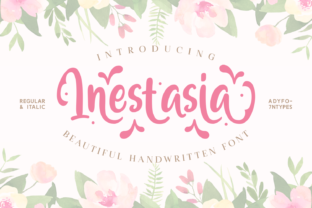
Inestasia: A Handwritten Script with Dramatic Curves
If you’ve ever paused mid-scroll because a logo, invitation, or social post felt unexpectedly warm and human—chances are, a script font like Inestasia was doing quiet, confident work behind the scenes. Inestasia isn’t just another handwritten font. It’s a premium font built around expressive, rhythmic curves—each letter leans, sways, or lifts like it’s breathing. There’s no rigid uniformity here. Instead, you’ll find subtle variations in stroke weight, organic entry and exit strokes, and generous spacing that invites the eye to linger—not rush.
More Than Just “Cute” — Personality You Can Trust
Inestasia carries a distinct personality: playful but never childish, elegant but never stiff. Its curves aren’t exaggerated for effect—they’re deliberate, balanced, and grounded in real handwriting rhythm. Think of it as the kind of script you’d use to sign a thoughtful note, not a neon-lit carnival poster. That nuance matters when building brand identity. A bakery launching artisan sourdough breads? Inestasia adds warmth and craft without leaning into cliché. A boutique wellness studio naming its new retreat series? The font conveys calm intention—not forced whimsy.
Unlike many modern script fonts that rely on sharp angles or tight loops to feel “contemporary,” Inestasia leans into softness and flow. It’s a display font first and foremost—designed to shine at larger sizes where its expressive details can be appreciated. That means it’s rarely ideal for body text in long-form editorial design or web articles. But in the right context? It becomes an instant tone-setter.
Where Inestasia Earns Its Place
Real-world usage is where Inestasia proves its versatility—and its limits. It excels in projects where voice, emotion, and distinction matter more than sheer efficiency:
- Logo design for small businesses rooted in care, creativity, or craft—think florists, ceramic studios, independent bookshops, or holistic practitioners.
- Social media graphics, especially Instagram carousels or Pinterest pins where a single headline needs to stand out amid visual noise.
- Packaging design for limited-edition products—soap labels, tea tins, or greeting cards—where tactile authenticity supports perceived value.
- Editorial design accents, like pull quotes in a magazine feature or chapter headers in a beautifully printed zine.
- Wedding stationery and personal branding assets (e.g., monogrammed notecards or signature seals) where individuality and sincerity are non-negotiable.
It’s less effective—and often counterproductive—in contexts demanding neutrality or speed: corporate dashboards, legal disclaimers, technical documentation, or mobile app interfaces where legibility at small sizes is critical. In those cases, pairing Inestasia with a clean sans serif (like Inter, Poppins, or even a refined serif like Lora) creates smart contrast and functional hierarchy.
Testing Fit Before Committing
Before licensing Inestasia, ask yourself three practical questions:
- Does this project benefit from a human, hand-crafted impression? If your audience expects precision, authority, or scalability above all else, a modern typography system built around geometric sans serifs may serve you better.
- Will the font appear where its details can be seen? Test it at the actual size it’ll be used—on screen and in print. At 14px on a mobile device, Inestasia’s delicate connections may blur or disappear. At 48pt on a poster? Those curves sing.
- What’s included in the package? Some versions of Inestasia offer only uppercase letters and basic punctuation; others include full OpenType features—alternates, ligatures, swashes, and multilingual support. Check the specimen PDF before purchase. If you need consistent lowercase forms for brand guidelines or want stylistic alternates for social variants, confirm those are present.
We once saw a food blogger license Inestasia for her recipe blog’s header—but then use it for all navigation labels and sidebar widgets. The result? Visual fatigue. Her readers couldn’t scan quickly, and the charm wore thin after three clicks. She switched to using Inestasia only for post titles and hero banners, paired with a relaxed, highly readable sans serif for everything else. Engagement metrics improved. Not because the font changed—but because its role did.
Pairing With Purpose, Not Just Contrast
Font pairing isn’t about opposites attracting—it’s about shared values with complementary roles. Inestasia pairs best with typefaces that respect its rhythm while offering structural clarity. Try:
- A warm, low-contrast sans serif like Quicksand or Manrope for digital projects where friendliness and readability both matter.
- A gentle serif like Cormorant Garamond or Playfair Display for print-heavy work—say, a quarterly newsletter or artisan product catalog.
- A neutral, highly legible sans like Inter or IBM Plex Sans when you need absolute clarity in supporting text without competing for attention.
Avoid overly decorative companions. Two expressive fonts rarely coexist gracefully. And skip ultra-thin or condensed sans serifs—they clash tonally with Inestasia’s generous, grounded curves.
Licensing & Practical Realities
Inestasia is a commercial font, meaning you’ll need a license for any public-facing or revenue-generating use—even if it’s just for your Etsy shop banner or Substack newsletter header. Most reputable foundries offer clear, tiered licensing: personal use, small business, extended (for unlimited users or large-scale distribution), and sometimes webfont or app embedding add-ons. Read the EULA. Seriously. We’ve seen designers unintentionally overstep by assuming “one license = one project” when their plan actually covered only desktop use—not web or video.
Also worth noting: Inestasia is not open source or free. That’s intentional. Its craftsmanship reflects time spent refining kerning pairs, balancing optical sizing, and ensuring cross-platform consistency. When you invest in a premium font like this, you’re not just buying characters—you’re acquiring tested design assets that reduce decision fatigue and elevate execution.
Ultimately, Inestasia works best when treated like a collaborator—not a shortcut. Use it where its humanity adds meaning. Step back where clarity demands silence. And always, always test it in context—not just in a font menu, but in the wild, where your audience lives.