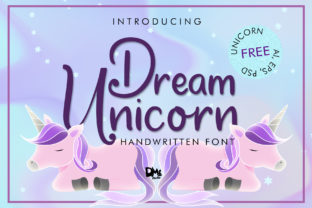
Dream Unicorn Font
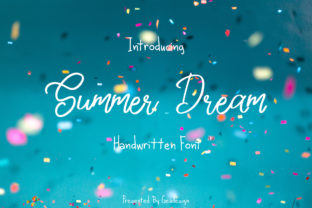
Dream Unicorn is a handwritten typeface designed with deliberate softness, gentle curves, and subtle irregularities that evoke sincerity and warmth—not perfection. It’s not a script meant for formal correspondence or data-heavy interfaces. Instead, Dream Unicorn serves a specific, well-defined niche: expressive, emotionally resonant visual communication where personality and charm matter more than neutrality.
What Makes Dream Unicorn Distinctive
Unlike many decorative handwritten fonts that rely on excessive flourishes or inconsistent baseline alignment, Dream Unicorn maintains strong typographic discipline. Its letterforms are carefully spaced, with balanced x-heights and generous counters—features that support legibility at moderate sizes (16–24 pt) in both digital and print applications. The lowercase ‘a’, ‘g’, and ‘y’ use single-story forms, reducing visual noise while preserving a friendly, approachable tone. Uppercase letters avoid sharp angles; instead, they flow with rounded terminals and light tapering strokes—consistent with the font’s overall ethos of calm sweetness.
The design avoids artificial “wobbly” effects often added post-draft to simulate hand-drawn authenticity. Every glyph was drawn by hand first, then digitized with fidelity to natural pressure variation—lighter lifts at stroke endings, slight swelling where pen naturally rests. That attention shows in real use: text set in Dream Unicorn feels intentional, not gimmicky.
Practical Use Cases and Real-World Performance
Dream Unicorn excels in contexts where tone and emotional resonance directly influence engagement. For example, educators crafting classroom welcome banners or printable mindfulness prompts find its rhythm supports calm focus without infantilizing content. Small business owners using it for boutique packaging—think handmade soap labels or ceramic studio tags—report customers consistently describe the typography as “thoughtful” and “inviting,” reinforcing brand values around care and craftsmanship.
Bloggers and content creators use Dream Unicorn selectively: not for body copy, but for pull quotes, section headers, or signature lines in email newsletters. In those roles, it performs reliably across platforms. Tested across modern browsers and recent versions of Adobe Creative Cloud, Figma, and Canva, Dream Unicorn renders cleanly—no glyph substitution issues, no missing diacritics in extended Latin characters (including accented vowels used in Spanish, French, and German). It includes standard OpenType features like ligatures and contextual alternates, though these are subtle—designed to enhance natural flow, not distract.
One limitation worth noting: Dream Unicorn is not optimized for long-form reading. Its low contrast and relaxed spacing reduce scannability in dense paragraphs. It also lacks true small caps, bold weights, or italic variants—so pairing requires thoughtful selection. A clean, moderately weighted sans-serif (e.g., Inter, Poppins, or Lato) works well as a functional counterpart for supporting text.
Complementing Dream Unicorn with Unicorn-Themed Design Elements
The font’s name isn’t just branding—it signals an intentional design ecosystem. The Dream Unicorn family includes a matching set of vector-based unicorn illustrations: minimalist silhouettes, delicate line art, and softly shaded icons—all created with the same hand-drawn sensibility. These aren’t clip-art style graphics. They share consistent stroke weight, curvature language, and negative space logic with the typeface itself.
This cohesion matters in practice. When combining Dream Unicorn text with its companion illustrations—for instance, a greeting card with “You’re magical” set in the font and a small horned silhouette tucked beside the ‘y’—the result feels unified, not pasted together. Designers report faster iteration times because alignment, scale, and stylistic harmony are pre-resolved. For crafters making printable planners or DIY party kits, this saves hours of manual adjustment.
The illustrations export cleanly at any size and work equally well in cut files (for Cricut or Silhouette machines) and digital layouts. No pixelation, no anchor point drift—just consistent, production-ready assets.
Audience Fit: Who Benefits Most—and Why
Dream Unicorn suits professionals and creators who prioritize emotional clarity over technical versatility. Freelance designers building brand identities for wellness studios, indie book publishers launching middle-grade chapter books, or Etsy sellers producing printable wall art all benefit from its focused strengths. It’s especially valuable when audience perception hinges on authenticity: parents choosing educational resources for young children, therapists designing client handouts, or nonprofit teams creating community outreach materials.
It’s less suitable for corporate annual reports, SaaS dashboard UIs, or multilingual publishing projects requiring extensive character sets (e.g., Cyrillic or CJK support). Those needs fall outside its scope—and that’s by design. Dream Unicorn doesn’t try to be everything. Its value lies in doing one thing well: helping human-centered messages land with warmth and sincerity.
Workflow Integration and Long-Term Usability
Installation is straightforward—standard .OTF or .TTF files compatible with macOS, Windows, and Linux systems. Licensing is clear: a single-user license covers personal and commercial use, including physical product sales (e.g., mugs, stickers, notebooks), provided the font isn’t embedded in editable templates distributed to others. There’s no subscription model or cloud dependency—meaning users retain full control over their files, version history, and output quality long-term.
From a maintenance standpoint, Dream Unicorn has proven stable across software updates. Unlike some newer variable fonts that occasionally trigger rendering inconsistencies in older PDF viewers or email clients, Dream Unicorn’s static weights render predictably—even in exported PDFs opened on mobile devices or legacy systems. That reliability reduces troubleshooting time and supports consistent delivery across channels.
Thoughtful Pairing and Responsible Usage
Because Dream Unicorn carries such distinct tonal weight, restraint enhances its impact. Overuse dilutes its effect; applying it to every heading, button, and caption flattens hierarchy and weakens emphasis. Stronger results come from strategic placement: a single headline, a short tagline, or a hand-lettered call-to-action within a larger layout anchored by neutral type.
Accessibility considerations also apply. While Dream Unicorn passes basic contrast checks against light backgrounds at 24 pt and above, it shouldn’t be used for critical interface text (e.g., form labels or navigation links) where WCAG AA compliance is required. Its role is expressive—not functional. Knowing that boundary helps users deploy it ethically and effectively.
In summary, Dream Unicorn delivers what it promises: a sincere, hand-crafted voice for projects where emotional resonance matters. It’s not a utility font—but then, it’s not meant to be. Its strength lies in specificity, consistency, and quiet confidence. When matched with its companion illustrations and deployed with intention, Dream Unicorn supports creative work that feels both personal and professionally grounded—without demanding compromise on quality or clarity.