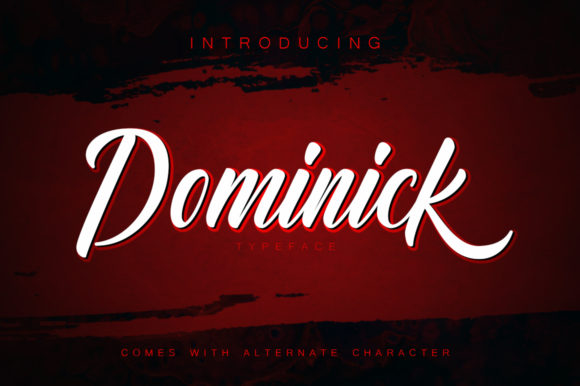
Dominick: A Handwritten Font That Feels Human—Not Hyped
Let’s be honest: most “handwritten” fonts on design platforms look like they were drawn by a robot trying to mimic cursive. Dominick isn’t one of them. It’s a bold, modern handwritten font built with rhythm, contrast, and subtle imperfection—like someone who writes beautifully but doesn’t overthink it. No stiff loops, no forced flourishes. Just confident strokes, natural spacing, and a warmth that reads as authentic—not staged.
When You Need Personality Without the Time to Draw It Yourself
You’re not a calligrapher—and you don’t need to be. Dominick bridges the gap between “I want this to feel personal” and “I need it done before lunch.” Think about the last time you designed a birthday card for a friend, mocked up an Instagram story for your small bakery, or drafted a welcome slide for your online workshop. In those moments, generic sans-serifs felt too cold. Script fonts felt either too fussy or too fragile. Dominick lands right in the middle: legible at small sizes, expressive at large ones, and versatile enough to hold its own next to clean typefaces or textured backgrounds.
Small Business Owners: From Menu Boards to Email Signatures
A coffee shop owner in Portland uses Dominick for their weekly chalkboard specials—digitally mocked up first in Canva, then printed on kraft paper. Why? Because customers notice the difference between “House Blend $4.50” in Helvetica and the same line in Dominick: one feels transactional; the other feels like a note from the barista who remembers your order. She also uses it sparingly in her email newsletter footer (“Thanks for being part of our little corner of the world”)—not as the main body text, but as a quiet signature touch that reinforces warmth without sacrificing readability.
Educators & Trainers: Making Learning Feel Inviting, Not Institutional
A high school science teacher uses Dominick for handout headers and slide titles—not for dense paragraphs, but for phrases like “What Happens Next?” or “Try This First.” Students respond better when material feels approachable, not intimidating. Dominick’s open letterforms and generous x-height mean it stays clear even when projected onto a slightly blurry classroom screen. One educator told us she stopped getting “Is this handwritten?” questions from students—because Dominick doesn’t scream “I tried to write this”—it just feels like a friendly, capable voice guiding them forward.
Bloggers & Content Creators: Standing Out in Crowded Feeds
If you’ve ever scrolled past ten identical-looking quote graphics on Instagram, you know how fast visual fatigue sets in. Dominick helps break that cycle—not by being louder, but by feeling more *present*. A freelance writer uses it for pull quotes overlaid on neutral photos: short lines like “Clarity starts with saying less” or “Your first draft is permission to be messy.” The font’s weight gives emphasis without shouting. Its slant leans forward—not backward—so it feels active, not nostalgic. And because it’s well-kerned and includes OpenType features (like contextual alternates), repeated letters like “ll” or “oo” don’t clash or look robotic.
Where Dominick Fits—and Where It Doesn’t
It’s not a replacement for body text in long-form articles. It’s not ideal for legal disclaimers or accessibility-critical interfaces. And if your brand voice is strictly minimalist, monoline, or ultra-technical (think aerospace engineering reports or medical device manuals), Dominick may feel tonally mismatched.
But in the spaces where tone matters as much as information—email subject lines, social banners, workshop workbooks, wedding invites, podcast cover art, product packaging labels, or even custom Notion templates—it adds dimension without distraction. It works especially well when paired with a neutral sans-serif (like Inter, Poppins, or Manrope) for contrast: Dominick handles the “what” and “why,” while the sans-serif handles the “how” and “when.”
Real Things to Consider Before You Use It
- Licensing matters. Dominick is free for personal use, but commercial projects—including client work, merch sales, or monetized content—require a license. Check the source: some sites bundle it with outdated licenses or unclear terms. Always verify permissions directly from the foundry or creator.
- Test it where it lives. Don’t judge Dominick solely in a font preview panel. Drop it into your actual tool—Figma, Adobe Express, Canva, or Google Slides—and see how it behaves at 24px on mobile, or scaled down for a printable checklist. Some handwritten fonts lose legibility fast; Dominick holds up well, but context changes everything.
- Less is often more. Using Dominick for every headline, button, and caption dilutes its impact. Reserve it for moments that benefit from human emphasis: a tagline, a call-to-action phrase, a section divider, or a short testimonial. Let it breathe—and let your audience feel the intention behind the choice.
- Pairing isn’t optional—it’s strategic. Dominick shines brightest when supported. Try it with a warm, low-contrast sans-serif for digital use, or a sturdy serif like Merriweather for print. Avoid pairing it with other scripts or overly decorative fonts—they’ll compete, not complement.
Why It Sticks With People (Beyond the Aesthetics)
There’s something quietly reassuring about using a font that looks like it was made by a person who understands restraint. Dominick doesn’t try to be everything. It doesn’t simulate ink bleed or paper texture unless you ask it to (via alternate glyphs). It doesn’t force personality—it lets yours come through instead.
A freelance illustrator uses it for client mood boards—not as branding, but as a consistent visual thread across color swatches, texture samples, and sketch notes. “It feels like the font is listening,” she said. “Not performing.”
A nonprofit fundraiser uses Dominick in donor thank-you PDFs, paired with simple line art illustrations. Recipients mention it—unprompted—in replies: “The whole thing felt so warm.” That’s not accidental. It’s what happens when typography supports emotion instead of overriding it.
You don’t need to be a designer to notice that difference. You just need to have opened an email, clicked a link, or paused on a poster long enough to feel something before you read a word. Dominick meets people in those micro-moments—and gives them a reason to stay.