Blington: A Modern Script Font for Natural-Looking Typography
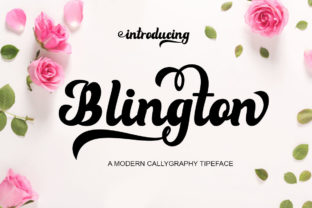
Blington is a contemporary script font designed to emulate the rhythm, variation, and expressiveness of authentic handwriting. Unlike decorative or highly stylized scripts, Blington prioritizes legibility and organic flow—featuring subtle stroke contrast, natural entry and exit strokes, and carefully calibrated letter connections that avoid mechanical uniformity. It was developed with digital use in mind, supporting OpenType features such as contextual alternates and ligatures to enhance realism without requiring manual glyph substitution.
People exploring typography for branding, editorial design, invitations, or digital interfaces often seek typefaces that convey warmth, personality, or approachability. Blington enters this space as a considered option—not as a novelty, but as a functional script that balances aesthetic appeal with practical application. Its design intent is clear: to offer the human touch of hand-lettering while maintaining the consistency and scalability required in professional design workflows.
Why Designers and Communicators Consider Blington
Interest in Blington typically arises when a project calls for visual tone that feels personal yet polished. This includes brand identities aiming for friendly sophistication—such as boutique studios, wellness services, artisanal food brands, or creative agencies seeking differentiation from sterile sans-serif dominance. It also appears in editorial contexts where headlines or pull quotes benefit from expressive contrast against neutral body text.
Another common trigger is the need for typographic hierarchy that avoids cliché. Many default script fonts rely on exaggerated flourishes or rigid calligraphic structures, which can feel dated or overly formal. Blington’s restrained execution makes it adaptable across media—from small-screen UI elements (with careful sizing and spacing) to large-format print—without sacrificing its core character.
Key Benefits and Realistic Expectations
One strength of Blington is its readability at moderate sizes. While most script fonts become illegible below 24–30pt in print or 20px on screen, Blington maintains clarity down to ~16px in well-spaced settings—particularly when used for short labels or accent text. Its OpenType support allows automated glyph variation, reducing the need for manual kerning adjustments in supported applications like Adobe Creative Cloud or modern web browsers using @font-face with font-feature-settings.
However, expectations must be grounded. Blington is not optimized for long-form body text. Its connected structure and variable stroke width reduce scanning efficiency in paragraphs. It also lacks extended language support beyond basic Latin characters—making it unsuitable for multilingual publishing without supplemental typefaces. Users should anticipate testing rendering across devices; like many variable-weight scripts, Blington may appear slightly lighter or less defined on low-resolution screens unless paired with appropriate fallbacks or CSS adjustments.
When Blington Is a Strong Fit
Blington works best in controlled, intentional applications. It excels in logo lockups where the wordmark benefits from fluid continuity—especially for names with rounded or open letterforms (e.g., “Luna,” “Milo,” “Olive”). It supports cohesive visual systems when paired with a neutral, highly legible sans-serif (such as Inter, Poppins, or Source Sans) for supporting text—creating contrast without dissonance.
It’s also effective in motion graphics and social media visuals where brief, impactful text overlays are needed. The font’s natural cadence translates well to animated reveals or typewriter-style effects, provided timing aligns with its inherent pacing. In packaging design, Blington adds tactile authenticity—particularly on products emphasizing craft, sustainability, or heritage—when applied to descriptors like “hand-poured,” “small-batch,” or “locally sourced.”
When to Explore Alternatives
Projects demanding high accessibility—especially those targeting users with dyslexia or low vision—should proceed cautiously. While Blington meets basic WCAG contrast requirements, its connected forms and variable x-height may hinder rapid character recognition for some readers. In such cases, more open, unconnected scripts like Quicksand or Playfair Display Italic (used sparingly) offer greater familiarity and decoding speed.
For technical documentation, SaaS dashboards, or data-heavy reports, Blington’s expressive nature becomes a liability. Here, clarity and neutrality take priority—making system fonts or robust grotesques like Roboto, Helvetica Now, or IBM Plex Sans more appropriate. Similarly, if licensing constraints apply (e.g., strict budget limits or restrictive embedding needs), free alternatives such as Pacifico or Shadows Into Light provide script-like qualities—but with tradeoffs in refinement and feature depth.
Practical Decision-Making Guidance
Before committing to Blington, evaluate three criteria: purpose, audience, and environment. Ask: Is the text serving as emphasis or information? Who will read it—and under what conditions (print, mobile, projected)? Does the surrounding design system support—or compete with—its stylistic voice?
A useful test is to set sample copy in context: mock up a business card, email header, or product label using your intended sizes and colors. Compare how Blington performs alongside your primary text font—not just visually, but functionally. Does it guide attention appropriately? Does it remain legible after scaling down by 20%? Does it retain its character when exported as SVG or embedded in a CMS?
Licensing is another concrete factor. Blington is typically distributed under commercial licenses that permit desktop, web, and app use—but terms vary by vendor. Always verify usage rights for your specific deployment method, especially if distributing templates or white-labeled tools where font redistribution may be restricted.
Final Considerations
Blington reflects a broader shift toward human-centered typography: one that values nuance over neutrality, but does so with intention rather than ornamentation. It is not a universal solution, nor is it meant to replace workhorse fonts. Instead, it fills a specific role—adding warmth and distinction where authenticity matters, without compromising professionalism.
If your goal is to signal care in craft, invite emotional connection, or differentiate through thoughtful detail, Blington warrants serious evaluation. If your priority is speed of comprehension, broad linguistic coverage, or strict adherence to functional minimalism, other options will better serve your objectives. As with any type choice, the strongest outcome comes not from selecting the most distinctive font—but the one whose behavior aligns most closely with what your audience needs, and what your content requires.