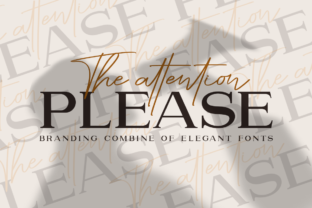
Attention: A Light, Elegant Font Designed to Stand Out Without Overpowering
Attention is a contemporary sans-serif typeface that balances visual lightness with structural clarity. It’s not merely thin—it’s thoughtfully weighted, with open counters, generous spacing, and subtle contrast in stroke modulation. Unlike ultra-light fonts that risk disappearing at small sizes or on low-resolution screens, Attention maintains legibility across contexts while preserving its refined character. Its elegance comes from restraint: no excessive flourishes, no forced personality—just clean geometry softened by humanist rhythm.
What Sets Attention Apart From Other Light-Footed Fonts
Many designers reach for light-weight fonts when aiming for airiness, minimalism, or modernity—but not all light fonts behave the same way. Some sacrifice readability for delicacy; others feel fragile or insubstantial in body text. Attention avoids those pitfalls through deliberate design decisions: slightly taller x-heights improve word recognition, terminals are gently tapered (not abruptly cut), and letterforms like “a,” “e,” and “g” retain familiar shapes rather than adopting abstract reinterpretations.
This makes Attention especially effective where tone matters as much as function—brand identities seeking sophistication without coldness, editorial layouts needing breathing room but not emptiness, or digital interfaces requiring scannability without visual fatigue. It works well at sizes ranging from 14px captions to 48px display headings, provided sufficient contrast and appropriate line height are maintained.
Where Attention Fits in the Broader Typographic Landscape
Attention belongs to a growing category of “light-but-legible” fonts—distinct from both traditional grotesques (like Helvetica Neue Light) and newer variable-font systems built for maximum flexibility. It’s less neutral than Inter Light, less geometric than Poppins Thin, and more intentional than generic system fonts set at font-weight: 200. That intentionality shows up in how it handles rhythm: lowercase “l” and “i” have differentiated shapes, ascenders clear descenders cleanly, and punctuation marks align with optical rather than mechanical centering.
Compared to serif alternatives—such as Adobe Garamond Premier Pro Light or EB Garamond—it trades historical warmth and textural richness for spatial efficiency and contemporary neutrality. That doesn’t make it “better,” but it does make it more suitable for environments where vertical space is constrained (mobile UIs, dashboards, compact packaging) or where typographic hierarchy relies heavily on weight variation rather than serifs or contrast.
Strengths Worth Considering
- Clarity at small sizes: Performs reliably down to 12–14px in UI contexts when paired with adequate line height (1.5–1.6) and letter spacing (0–2% tracking).
- Tonal consistency: Maintains its voice across weights—regular, medium, and bold versions share proportion and spacing logic, reducing visual dissonance in layered typography.
- Print and screen versatility: Optimized hinting supports crisp rendering on older Windows devices, while OpenType features (ligatures, small caps, stylistic alternates) extend expressive range for print or high-fidelity web use.
- Emotional resonance: Communicates calm confidence—not austerity, not whimsy, but quiet assurance. Useful for healthcare, education, sustainability brands, or any context where authority must feel approachable.
Realistic Tradeoffs and Limitations
Attention isn’t universally ideal. Its lightness means it struggles in low-contrast environments—think light gray text on off-white backgrounds—or when rendered over busy imagery without solid overlays. It also lacks the robustness needed for dense long-form reading (e.g., novels, academic journals, legal documents), where higher stroke contrast and stronger rhythm cues support sustained focus.
Another consideration: Attention is a single-family offering, not part of a broader superfamily with slab, mono, or display variants. If your project demands typographic diversity—code snippets alongside headlines alongside pull quotes—you’ll need to pair Attention carefully with complementary faces, rather than rely on internal family expansion.
When Attention Is the Right Choice
Consider Attention if your goals include:
- Creating visual distinction without visual noise: For example, a boutique hotel website using Attention for navigation and subheadings, paired with a warm, slightly heavier serif for body copy—achieving hierarchy through contrast in weight and texture, not size alone.
- Designing for accessibility-aware audiences: While not WCAG-certified out of the box, Attention’s generous apertures and consistent stroke endings support users with mild dyslexia or low vision better than many ultra-condensed or monolinear alternatives.
- Building brand cohesion across touchpoints: Its balanced proportions translate well from app interfaces to business cards to presentation decks—reducing the need for constant font substitution or visual recalibration.
- Expressing modernity with maturity: Startups often default to bold, high-contrast fonts to signal energy. Attention offers an alternative path: signaling innovation through refinement instead of volume.
When You Might Choose Something Else
Attention may not be optimal if:
- You’re designing for environments with inconsistent rendering—such as legacy email clients or embedded kiosks—where broader, more forgiving fonts (like Roboto or Source Sans) provide greater predictability.
- Your content prioritizes speed of comprehension over aesthetic nuance—for instance, safety signage, real-time data dashboards, or multilingual interfaces where character width variation across scripts introduces layout instability.
- You require extensive language support beyond Latin-based scripts. Attention currently covers Western, Central, and Eastern European languages, plus basic Vietnamese and Turkish, but lacks full Cyrillic, Greek, or extended Arabic coverage.
- You need tight vertical rhythm in narrow columns—Attention’s tall x-height and ascenders can increase line count compared to fonts with compressed proportions (e.g., IBM Plex Sans or Work Sans).
Practical Pairing and Implementation Notes
Attention pairs most effectively with typefaces that offer either grounding or counterpoint. For balance, try it with a sturdy, low-contrast serif like Freight Text or Charter. For contrast, combine it with a monospaced face like Fira Code (for technical documentation) or a humanist sans like Lato (for supporting UI elements). Avoid pairing it with other ultra-light fonts—the result can feel insubstantial or indecisive.
In web implementation, serve Attention via Google Fonts or self-hosted WOFF2 files. Always declare fallbacks: font-family: "Attention", -apple-system, BlinkMacSystemFont, "Segoe UI", Roboto, sans-serif;. Use @font-face rules with font-display: swap to prevent invisible text during load, and test rendering across iOS, Android, and desktop Chrome/Firefox/Safari.
Making Your Decision Thoughtfully
Choosing a font isn’t about finding the “best” option—it’s about identifying the most appropriate tool for a specific communicative task. Attention excels when you need lightness with integrity, elegance with utility, and modernity with restraint. It won’t solve poor information architecture or weak content strategy, but it can elevate both—by giving readers space to breathe, time to absorb, and reason to pause.
If your project values subtlety over statement, precision over prominence, and harmony over hierarchy-by-weight alone, Attention deserves serious evaluation. But if your needs lean toward maximum compatibility, broad linguistic coverage, or high-density readability, explore alternatives with different priorities—and do so with the same care you’d apply to any foundational design decision.