Venice Family: A Modern Serif Font Built for Clarity and Character
When choosing a typeface for a project—whether it’s a brand identity, a long-form website, a printed annual report, or even an internal dashboard—the decision goes far beyond aesthetics. You’re selecting a voice. One that must communicate authority without stiffness, warmth without informality, and distinction without distraction. Venice Family meets that need precisely: it’s a modern and functional serif font family whose sleek structure delivers strong personality while maintaining exceptional readability across devices and contexts.
Many professionals face recurring typography challenges—not because they lack taste, but because they lack a type system that balances intention with practicality. Designers juggle tight deadlines and shifting brand guidelines; content strategists worry about engagement drop-offs on mobile screens; developers need fonts that render consistently and load efficiently; and marketing teams seek visual cohesion across email, web, and print. In each case, the wrong font can silently erode trust, slow comprehension, or dilute impact—even before a single word is read.
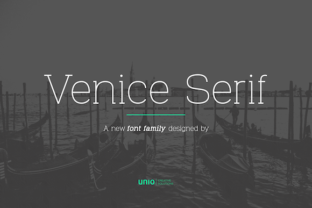
Venice Family was crafted to resolve those tensions. It’s not a revival of historical models nor a minimalist experiment—it’s a purpose-built serif designed for today’s communication landscape. Its vertical stress, open apertures, and carefully calibrated x-height support legibility at small sizes and on low-resolution displays. At the same time, its refined contrast, subtle bracketing, and distinctive letterforms—like the elegant curve of the lowercase g or the confident stance of the capital V—give it unmistakable presence. That duality—functional clarity paired with quiet confidence—is what makes Venice Family especially valuable for real-world use.
Consider a nonprofit launching a new donor-facing website. They need text that feels trustworthy and human—not cold or corporate, but also not overly casual. Venice Family’s Regular and Medium weights offer ideal body copy density, while its SemiBold and Bold variants provide clear, uncluttered hierarchy for headlines and callouts. Because it’s optimized for both screen and print, the same font can scale seamlessly from responsive web layouts to fundraising brochures—reducing design overhead and ensuring message consistency.
For editorial teams publishing long-form articles or digital magazines, Venice Family supports sustained reading. Its generous spacing, balanced rhythm, and thoughtful punctuation design (including true italics with distinct cursive forms—not just slanted romans) reduce eye fatigue. Unlike some “modern serifs” that sacrifice warmth for geometry, Venice retains organic flow in its curves and terminals, helping readers stay immersed rather than distracted by awkward letterfit or abrupt weight transitions.
Developers appreciate Venice Family’s technical readiness. It ships with full OpenType features—including ligatures, small caps, old-style figures, and language-specific alternates—enabling rich typographic control without custom coding. It’s available in variable and static formats, so teams can choose performance-optimized subsets for web use or full-feature versions for desktop publishing. And because it’s built with consistent metrics across weights and widths, switching between Venice Light Italic and Venice Bold Condensed won’t break layout grids or require manual reflow.
Different users approach Venice Family with different priorities—and that’s by design. A branding agency might start with its Display weight for logo lockups and hero banners, then layer in Text and Caption cuts for UI labels and footnotes. A university communications team may adopt Venice Family as their institutional type system: using Venice Serif for academic publications and Venice Sans (a complementary sans-serif companion) for digital signage and wayfinding—creating harmony without monotony. An indie publisher could license Venice Family for eBook typography, leveraging its robust hinting and Unicode coverage to ensure clean rendering across Kindle, Apple Books, and EPUB readers.
Implementation doesn’t require overhauling your entire workflow. Start small: replace a generic serif like Georgia or Times New Roman in your next email newsletter template. Test how Venice Family’s Medium weight performs at 16px on mobile—note how its open counters and generous spacing improve scanability. Then expand: apply Venice Bold for section headers, pair it with a neutral sans-serif for data tables, or use its italic variants to emphasize key quotes without resorting to bolding or color shifts.
One practical consideration: Venice Family thrives when given room to breathe. Avoid cramming too much tracking (letter-spacing) into body text—its natural rhythm works best with default or slightly increased values. For accessibility, stick to WCAG-compliant contrast ratios (4.5:1 minimum for body text), and remember that Venice Family’s high legibility means you can often use lighter weights (e.g., Venice Light) at larger sizes without sacrificing readability—offering elegant visual variety while staying inclusive.
Another strength lies in its adaptability across tone. Need gravitas? Venice Bold in all-caps for a mission statement. Want approachability? Venice Regular at 20px with generous line height for a blog post intro. Seeking sophistication without pretension? Venice Italic for pull quotes or attribution lines. Because Venice Family avoids extreme contrast or eccentric details, it never competes with content—it elevates it.
If you’ve ever hesitated to use a serif font online for fear of poor rendering, or avoided a “designer font” because of licensing complexity or limited language support, Venice Family offers a pragmatic alternative. It supports Latin, Greek, Cyrillic, and extended Latin scripts—including Vietnamese and Turkish characters—making it viable for global brands and multilingual publications. Its licensing options include web-only, desktop, app, and enterprise tiers, so whether you’re a solo creator or a multinational corporation, there’s a path to implementation.
Ultimately, Venice Family isn’t about chasing trends—it’s about solving problems quietly and effectively. It answers the unspoken needs behind every font choice: Will this hold attention? Will it scale reliably? Will it feel intentional, not arbitrary? By grounding its design in real-world constraints—screen resolution, reading distance, cognitive load, and cross-platform consistency—Venice Family becomes more than a typeface. It becomes infrastructure for clear communication.
So the next time you’re selecting a font—not as decoration, but as a tool—consider what Venice Family brings to the table: reliability you can build on, character you can trust, and readability that works for everyone, not just designers. It’s the kind of typeface that disappears into the background… until someone notices how effortlessly they understood every word.