Summer Rain Font
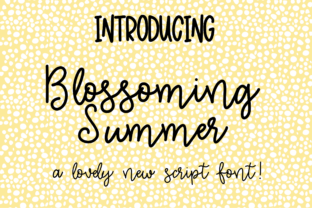
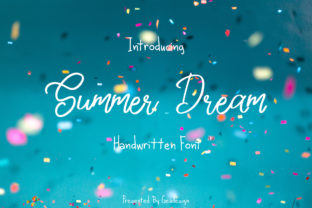
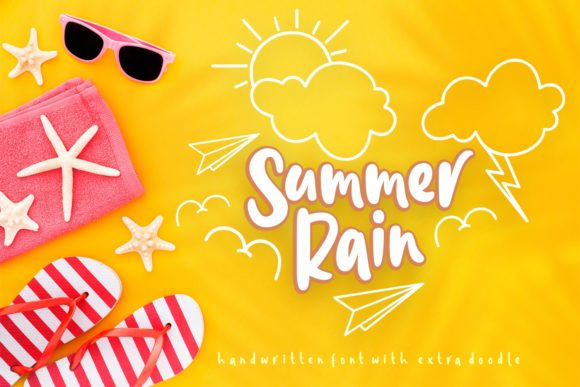
Summer Rain is a charming handwritten typeface designed to evoke lightness, spontaneity, and quiet optimism. Its letters flow with subtle irregularities—slight variations in stroke weight, gentle swashes, and relaxed spacing—that mimic natural pen-on-paper movement. It is not a calligraphic display font with dramatic flourishes, nor is it a tightly kerned script meant for formal invitations. Instead, Summer Rain occupies a middle ground: legible enough for short headlines and captions, expressive enough to convey warmth and approachability.
Why Designers Consider Summer Rain
Designers often seek typefaces that reinforce tone without overwhelming content. Summer Rain appeals most when the goal is to soften visual hierarchy, add personality to digital or print projects, or signal friendliness and authenticity. Its casual rhythm makes it a candidate for branding aimed at lifestyle, wellness, education, or creative small businesses—particularly those emphasizing mindfulness, seasonal themes, or handmade aesthetics.
Unlike monoline scripts or rigid sans-serifs, Summer Rain introduces subtle human variation. This can help counteract the perceived coldness of digital interfaces or overly polished layouts. For readers evaluating fonts, this trait may align with goals like increasing perceived empathy in user-facing materials—or distinguishing a brand voice in saturated markets where uniformity is common.
Practical Benefits and Realistic Tradeoffs
The primary benefit of Summer Rain lies in its tonal consistency: it reliably communicates ease and sincerity across sizes and contexts where it’s appropriately applied. It performs well in headings up to 48–60px, especially over light or muted backgrounds. Its open letterforms and moderate x-height support readability at larger sizes, and its lowercase ‘a’, ‘g’, and ‘e’ retain clarity without sacrificing character.
However, tradeoffs exist. Summer Rain is not intended for body text. Its irregular baseline and variable spacing reduce scanning efficiency below ~24px. It lacks extensive language support beyond basic Latin characters, and its OpenType features are limited—no stylistic alternates, no small caps, and minimal figure sets. Users requiring multilingual publishing, accessibility compliance (e.g., WCAG contrast or screen reader compatibility), or typographic flexibility across dense layouts should evaluate these constraints carefully.
Also consider licensing. While many handwritten fonts are available under free or low-cost licenses, Summer Rain typically requires a commercial license for use in client work, merchandise, or web embedding. Always verify usage rights before implementation—especially if deploying via CSS @font-face or integrating into SaaS platforms.
When Summer Rain Fits Well
Summer Rain is a strong fit in focused, intentional applications. Examples include:
- Logo lockups or wordmarks for brands centered on relaxation, nature, or personal growth—such as yoga studios, botanical skincare lines, or independent bookshops.
- Editorial accents in newsletters or blogs where tone matters more than density—like pull quotes, section dividers, or feature image overlays.
- Print collateral with limited text volume, such as postcards, recipe cards, or workshop handouts, where tactile feel and visual warmth enhance perceived value.
- Digital banners or social media graphics where brief, emotionally resonant messaging benefits from expressive typography—provided sufficient contrast and size ensure legibility on mobile.
In each case, success depends less on the font itself and more on how deliberately it’s deployed. Using Summer Rain sparingly—as one voice among a balanced typographic system—preserves its impact. Overuse dilutes distinction and risks visual fatigue.
When Alternatives May Be More Suitable
Not every project calling for “handwritten” or “friendly” typography needs Summer Rain. If your use case involves:
- Long-form reading: Choose a highly legible serif or humanist sans-serif instead. Fonts like Playfair Display (for elegance) or Inter (for neutrality and performance) offer better scannability and accessibility support.
- Brand scalability: A custom or modular script may better accommodate future extensions—such as icon integration, variable weight axes, or extended language coverage—than a static handwritten design like Summer Rain.
- Tight layout constraints: If space is limited (e.g., app UI labels or data dashboards), a compact, high-x-height sans-serif will outperform any script font in clarity and function.
- High-contrast environments: In outdoor signage or low-resolution screens, Summer Rain’s delicate strokes may blur or disappear. A bolder, more geometric alternative ensures message retention.
Making an Informed Choice
Evaluating Summer Rain isn’t about whether it’s “good” in absolute terms—it’s about alignment. Ask yourself:
- What emotion or impression must the text communicate—and does Summer Rain reinforce that without distraction?
- How much text will appear in this font? If more than a few words per instance, test readability at actual viewing distance and device size.
- Does the project require technical robustness—like responsive scaling, dynamic text resizing, or translation? If yes, assess fallback behavior and test rendering across browsers and operating systems.
- Is there a clear typographic hierarchy in place? Summer Rain works best alongside a neutral companion font (e.g., a clean sans-serif for body copy) to avoid visual competition.
Finally, test early and often. Render sample text in context—not just as isolated letters, but against real backgrounds, alongside real imagery, and at real sizes. Compare side-by-side with alternatives that share similar intent (e.g., Quicksand, Caveat, or Amatic SC) to gauge relative warmth, rhythm, and appropriateness. Let observed performance—not first impressions—guide the decision.
Ultimately, Summer Rain offers a specific kind of expressive utility. It won’t solve layout problems or replace sound information architecture. But when matched thoughtfully to purpose, audience, and medium, it can quietly strengthen connection—making written language feel less like transmission, and more like conversation.