All Caps
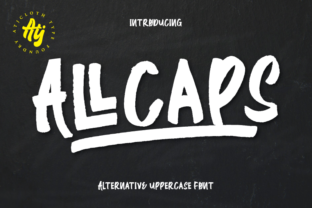
Imagine opening a design file and instantly feeling the energy shift—not because of color or layout, but because the text itself looks like it’s been screen-printed on vintage denim, stamped into concrete, or scrawled with a charcoal stick. That’s All Caps: a textured brush font with a cool, unpolished vibe that adds a rough, human twist to clean layouts, bold statements, and creative experiments.
What All Caps Actually Does—Not Just What It Looks Like
It’s not just “uppercase letters with grit.” All Caps is built from hand-drawn strokes—each capital letter carries subtle irregularities: uneven weight, slight tapering at the ends, organic spacing, and a tactile grain that mimics real-world mark-making. That means it doesn’t sit quietly in the background. It draws attention *with intention*. And because it’s strictly uppercase (no lowercase variants), it naturally commands focus—ideal for headlines, logos, posters, or short bursts of high-impact messaging.
Where It Fits—Without Trying Too Hard
You don’t need a branding agency or a design degree to use All Caps well. In fact, its strength lies in how easily it slots into everyday creative work—when the goal isn’t perfection, but presence.
For the Freelancer Pitching a Bold New Look
A freelance web designer sends a mood board to a café owner who wants “something that feels local, alive, not corporate.” Instead of defaulting to sleek sans-serifs, they drop All Caps into a mockup of the homepage banner: “OPEN DAILY • 7AM–9PM”. Instantly, the tone shifts—from generic to grounded, from transactional to inviting. The texture hints at hand-painted signage; the all-caps rhythm feels confident, not shouty. No extra explanation needed—the font does quiet storytelling.
For the Educator Making Learning Feel Less Static
A middle school science teacher prints lab safety rules on bright cardstock. Using All Caps for headers like “WASH HANDS BEFORE LEAVING” or “NO FOOD IN LAB” makes them feel less like bureaucratic reminders and more like urgent, human-to-human notes. Students notice—not because it’s loud, but because it breaks the monotony of standard classroom fonts. It subtly signals: *This matters, and it’s meant for you.*
For the Small Business Owner Updating Their Social Feed
A ceramicist posts a new mug collection on Instagram. Her usual captions use clean, minimalist type—but this time, she overlays All Caps on a flat-lay photo: “HAND-THROWN • SMALL BATCH • MADE IN OAKLAND.” The texture echoes the clay’s surface; the caps match the physicality of her process. Engagement ticks up—not because of algorithm hacks, but because the typography feels aligned with her craft. Followers comment things like *“This font gets you”*—a sign the visual language landed.
For the Blogger Building Visual Consistency
A personal finance blogger uses All Caps sparingly but strategically: only for recurring section headers in her newsletter (“THIS WEEK’S MOVE”, “MONEY MYTH BUSTED”). It creates rhythm across issues without demanding attention every time. Readers begin to associate that textured boldness with clarity and action—not fluff. Over time, it becomes part of her voice, not just decoration.
When All Caps Might Not Be the Right Call
Like any expressive tool, it works best when matched to purpose—not just preference. Ask yourself:
- Is legibility critical at small sizes? All Caps shines at 24pt and up. Below 16pt—especially on screens—it can blur or fatigue the eye. Avoid body copy, footnotes, or dense UI labels.
- Does the message need warmth or approachability over edge? A childcare app using All Caps for button text (“BOOK A TOUR”) may unintentionally feel stern. Softer alternatives often serve empathy-driven contexts better.
- Is brand consistency already locked in? If your logo, website, and print materials rely on a highly refined serif or geometric sans, dropping in All Caps mid-campaign can jar rather than energize—unless it’s deliberately used as a controlled accent (e.g., only on event posters or limited-edition packaging).
How to Use It Without Overdoing It
The most effective uses treat All Caps like a spice—not the main ingredient. Try these practical pairings:
- With neutral sans-serifs: Pair it with Inter, Lato, or Open Sans for contrast that feels intentional, not chaotic.
- In single-line emphasis: One phrase per image or slide. More than that dilutes its impact.
- On textured or muted backgrounds: It sings against kraft paper, linen canvas, or soft gray—not glossy white or neon gradients (unless that’s the exact vibe you’re after).
- In motion graphics: Animate letters appearing one by one with a slight stagger and subtle “ink bleed” effect—reinforcing its handmade origin.
Real Talk About Getting Started
All Caps is widely available as a desktop font (OTF/TTF) and supported in tools like Adobe Creative Cloud, Figma, Canva Pro, and Affinity Designer. Free versions exist—but many lack full character sets (no numbers, no punctuation, limited accents), which limits real-world use. Paid versions typically include extended Latin support, stylistic alternates, and variable weight options—worth it if you’ll use it regularly across client work or product launches.
If you're downloading for the first time, test it in context before committing: paste your actual headline into a mockup, check it on both desktop and mobile, and ask someone else to read it aloud. Does it sound like what you meant to say? Does it feel like *your* voice—or just a trend you borrowed?
Why It Sticks Around (Beyond the Aesthetic)
Trends fade. Tools become obsolete. But fonts like All Caps endure because they answer a quiet, persistent need: to make digital communication feel less automated and more human. In a world saturated with AI-generated content and templated designs, choosing a textured brush font is a small act of intention. It says: *I made this. I chose this. This matters enough to give it texture.*
That’s why illustrators use it on zine covers, podcasters on episode thumbnails, nonprofit teams on rally posters, and even HR managers on internal culture campaign banners. Not because it’s “trendy”—but because it fits where authenticity needs to show through, not be smoothed over.
So go ahead—try it on your next banner, your workshop title slide, your product tagline, or even your weekly planner header. Just remember: let the roughness serve the message, not distract from it. All Caps doesn’t ask you to be louder. It asks you to be bolder—in the right places, at the right time.