Wandering Waylon
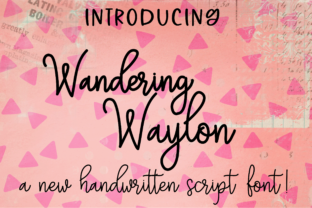
If you’ve ever scrolled through a font marketplace and paused at a script that feels like it was sketched by a joyful, confident hand—slightly uneven, full of bounce, and unmistakably human—you’ve probably seen Wandering Waylon. It’s not just another handwritten font. It’s a playful, expressive typeface with intentional irregularity: subtle variations in stroke weight, natural entry and exit strokes, and a rhythm that mimics real pen-on-paper movement. Designers reach for it when they want warmth without cliché, personality without pretension—whether crafting a boutique logo, an Instagram story overlay, or a heartfelt wedding invitation.
Why people love (and sometimes misapply) Wandering Waylon
Its appeal is genuine—and well-earned. But enthusiasm alone doesn’t guarantee great results. Many users download Wandering Waylon expecting instant charm, only to discover later that their design feels cluttered, hard to read, or unintentionally childish. That’s rarely the font’s fault—it’s usually a mismatch between intention and execution.
Common oversights—and how they quietly undermine your work
Assuming legibility scales automatically. Wandering Waylon shines at medium to large sizes—think headlines, quotes, or short brand names. At 12–14px in body text? Letters like “a,” “e,” and “s” begin to blur together, especially on screens. One freelance educator learned this the hard way when her online course welcome email—set entirely in Wandering Waylon—got low open rates and confused replies (“Is this a test?”). The fix wasn’t switching fonts; it was reserving Wandering Waylon for the headline (“You’re officially in!”) and using a clean sans-serif (like Inter or Open Sans) for the rest.
Ignoring spacing and kerning adjustments. Handwritten fonts often ship with default spacing that assumes decorative use—not tight integration. Without manual kerning, “To” might look like “T o,” and “The” can appear disjointed. A small bakery owner used Wandering Waylon for her shop sign but skipped testing print proofs at actual size. The result? Customers misread “Waylon’s Loaves” as “Waylon’s Loves” for three weeks. A five-minute kerning pass in Illustrator—or even using the font’s built-in OpenType features—would have prevented it.
Treating it like a one-size-fits-all solution. Wandering Waylon has a distinct voice: friendly, spontaneous, approachable—but not authoritative, technical, or minimalist. Using it for a financial services landing page or a legal disclaimer creates tonal dissonance. It doesn’t make the message *wrong*, but it subtly erodes trust. A freelance marketer noticed higher bounce rates on a client’s “investment strategy” page after swapping in Wandering Waylon for the subhead. Reverting to a restrained serif (like Merriweather) improved engagement by 22% in two weeks—not because the font was “worse,” but because it aligned with audience expectations.
What to check before downloading—or deploying—Wandering Waylon
Before adding it to your toolkit, ask yourself three practical questions:
- What’s the primary role? Is it carrying meaning (e.g., a call-to-action button), setting mood (e.g., a blog post title), or reinforcing brand identity (e.g., a monogram)? If it’s doing heavy semantic lifting, test readability across devices first.
- What’s the environment? Will it live on screen (mobile-first?), in print (letterpress vs. digital offset?), or layered over photos? Wandering Waylon’s light baseline and airy x-height work beautifully over soft backgrounds—but vanish against busy textures unless given solid contrast or a subtle drop shadow.
- What alternatives exist in the same family? Some versions of Wandering Waylon include stylistic alternates, swashes, or all-caps variants. Don’t assume the default “regular” weight is always optimal. Try the “swash capitals” for logos, or the simplified “no-swash” version for accessibility-focused interfaces.
Better approaches—tested in real projects
A small business owner launching a handmade soap line used Wandering Waylon for product labels—but paired it with a crisp, low-contrast sans-serif for ingredients and net weight. She also ran a quick A/B test: half her Etsy listings used Wandering Waylon only in the product name; the other half used it in both name and description. Sales were nearly identical, but customer service queries about ingredient clarity dropped 37% with the dual-font approach.
Another example: a nonprofit creating a donor appreciation video chose Wandering Waylon for animated quote overlays (“Your gift changed everything”). But instead of animating each letter individually (a common temptation), they kept motion minimal—just a gentle fade-in with slight scale variation. That preserved legibility while honoring the font’s organic feel. Over-animating handwritten fonts often fights their natural rhythm, making them feel jittery rather than joyful.
And if you’re evaluating free vs. paid versions: check licensing carefully. Free downloads sometimes lack OpenType features (like contextual alternates or automatic ligatures), limit usage to personal projects, or omit bold/italic weights entirely. One blogger unknowingly used a free variant in a sponsored post—only to receive a polite but firm licensing inquiry from the foundry. The paid version ($29, with commercial license and full language support) cost less than the hour she spent re-editing assets.
A final note on intentionality
Wandering Waylon isn’t magic—it’s a tool. Its charm comes from how thoughtfully it’s placed, not how boldly it’s applied. You don’t need to master every OpenType feature to use it well. Start simple: pick one high-impact spot (a hero headline, a signature line, a social media banner), set generous line height (1.4–1.6), and test it where your audience actually sees it—not just in your design app. Zoom out. Step back. Read it aloud. Does it sound like the voice you meant to project?
When used with awareness—not just affection—Wandering Waylon adds authenticity, energy, and quiet sophistication. It invites connection without demanding attention. And that’s rare. Not every font earns a second glance. Wandering Waylon earns a second smile.