To Japan
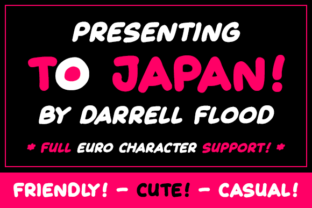
“To Japan” is not a destination—it’s a typographic decision with deliberate expressive weight. It’s an ultra-casual handwritten font rendered in a bubbly, bold style: rounded letterforms, uneven baseline rhythm, generous spacing, and a playful sense of spontaneity. Designed for immediacy and warmth, it doesn’t whisper—it grins. And while its visual language leans cartoonish, its strategic utility extends far beyond comic strips. For professionals who shape messages, build brands, or guide audiences—this font is a tool worth understanding—not as decoration, but as intention made visible.
Why “To Japan” Works Where Other Fonts Don’t
Typography isn’t neutral. Every typeface carries implicit associations: formality, authority, playfulness, urgency, nostalgia, or approachability. “To Japan” communicates accessibility without sacrificing impact. Its bubbly contours soften hierarchy; its bold weight ensures legibility even at small sizes or on low-resolution screens. That combination makes it uniquely suited for contexts where clarity must coexist with emotional resonance—especially when targeting attention-fatigued adults aged 20–50.
Consider this: a small business owner launching a new workshop series for creative professionals might choose “To Japan” for event banners—not because it’s “fun,” but because it signals openness, low barriers to entry, and human-centered design. A freelance educator building a course on creative problem-solving may use it for section headers in their learning platform—not to mimic childishness, but to visually reinforce that complex ideas can be approached with curiosity, not intimidation.
Strategic Use Cases Beyond the Obvious
Most users encounter “To Japan” in illustration-heavy environments: children’s book covers, indie comic panels, or social media stickers. But its real strategic value emerges when applied with discipline—not as background texture, but as a calculated signal within a broader system.
- Brand voice calibration: If your brand positions itself as expert yet empathetic (e.g., a mental wellness app, a sustainable fashion label, or a professional development newsletter), “To Japan” can temper technical credibility with relatability—especially in headlines, CTAs, or microcopy like “Let’s begin” or “You’ve got this.”
- Information hierarchy refinement: In digital interfaces or printed guides, using “To Japan” for primary action labels (“Start now,” “Add to cart,” “Join the list”) creates visual contrast against neutral body text (e.g., Inter, Lato, or Roboto). That contrast directs attention without shouting—and does so in a way that feels intentional, not gimmicky.
- Learning material scaffolding: Educators and instructional designers report stronger engagement when “To Japan” anchors reflective prompts (“What surprised you?”) or collaborative cues (“Sketch your idea here”) in workbooks or slide decks. The font subtly lowers the psychological threshold for participation—particularly among adult learners wary of “getting it wrong.”
When “To Japan” Should Stay in the Toolkit—Not on the Page
Like any high-character font, “To Japan” carries risk when deployed without alignment to purpose. Its strength is specificity—not versatility. Using it for long-form body copy undermines readability. Applying it across all headings dilutes its emphasis. And inserting it into contexts demanding gravitas—legal disclaimers, investor pitch decks, clinical guidelines—creates dissonance that erodes trust.
The most common misstep? Assuming “playful” equals “unprofessional.” That’s a false binary. Professionalism resides in appropriateness—not austerity. A financial advisor using “To Japan” for a client-facing worksheet titled “Let’s map what matters to you” demonstrates confidence in human-centered service—not a lack of rigor. The same advisor using it for quarterly performance reports would undermine credibility. Context defines correctness.
How to Integrate “To Japan” With Intention
Start with outcome—not aesthetics. Ask: What do I want the reader to feel, understand, or do next? Then ask: Does “To Japan” support that outcome more effectively than alternatives? If yes, proceed deliberately:
- Limit scope: Restrict “To Japan” to one functional role per project—e.g., only for primary buttons, only for section dividers, only for quote callouts. Consistency builds recognition; overuse breeds noise.
- Pair intentionally: Pair it with a highly legible, neutral sans-serif (e.g., Open Sans, Helvetica Neue, or IBM Plex Sans) for supporting text. Avoid other decorative fonts—contrast should come from function, not flourish.
- Test real usage: Preview “To Japan” in actual environments—not just mockups. Does it render cleanly on mobile Safari? Is it legible against textured backgrounds? Does it scale predictably in responsive layouts? Tools like Google Fonts’ preview panel help—but nothing replaces real-device testing.
- Check cultural resonance: While “To Japan” evokes lighthearted energy, avoid pairing it with imagery or language that appropriates or flattens Japanese culture. Its name references tone and texture—not geography. Use it to express warmth and informality, not as shorthand for “Asian-inspired.”
Risks of Defaulting to “To Japan” Without Strategy
Using “To Japan” reflexively—because it’s free, trendy, or “just feels right”—introduces subtle but meaningful friction. Readers subconsciously assess coherence: if your logo uses sharp geometric type, your website navigation uses clean sans-serifs, and suddenly your email subject line bursts in bubbly script, the disconnect registers as inconsistency—not charm. That erosion of coherence weakens brand recall and dilutes message authority.
Worse, overreliance on expressive fonts like “To Japan” can mask underdeveloped strategy. A startup using it across all touchpoints may believe they’re projecting “approachability”—but if their pricing page lacks clarity or their onboarding flow confuses users, no font will compensate. Typography amplifies intent; it doesn’t replace it.
Long-Term Value Lies in Alignment, Not Aesthetics
“To Japan” endures not because it’s novel, but because it solves a persistent communication challenge: how to convey warmth without vagueness, energy without chaos, simplicity without oversimplification. Its longevity depends on disciplined application—not frequency of use.
For marketers, that means auditing every customer-facing asset: does “To Japan” appear where it strengthens, not obscures, the core message? For educators, it means asking whether its presence invites deeper engagement—or merely distracts. For entrepreneurs, it’s about whether this font helps clarify their unique value proposition—or blurs it behind stylistic noise.
That level of scrutiny applies equally to serif fonts, monospaced type, or variable fonts. What makes “To Japan” distinctive is its narrow band of optimal utility—and the clarity required to recognize when that band aligns with your goals. It’s not for every headline. It’s for the right headline, at the right moment, serving the right outcome.
Practical Next Steps
If you’re evaluating “To Japan” for an upcoming project, begin with these actions:
- Map one key user journey—e.g., how a visitor moves from landing page to sign-up—and identify up to two points where emotional tone directly impacts conversion. Test “To Japan” there first.
- Compare side-by-side with two alternatives: one neutral (e.g., Montserrat Bold), one similarly expressive but structurally different (e.g., Comic Neue). Note where “To Japan” improves scannability, reduces perceived friction, or increases dwell time.
- Document your rationale—not just “it looks friendly,” but “we chose ‘To Japan’ for the ‘Get Started’ button because usability testing showed users hesitated less when the CTA felt invitationally bold rather than transactionally urgent.” That documentation becomes invaluable during future audits or team handoffs.
“To Japan” is not a shortcut. It’s a lever—one that multiplies impact when pulled with precision, and introduces drag when yanked without direction. Use it not to make things look more interesting, but to make them work better—for your audience, your goals, and your long-term credibility.